
Tewkesbury Abbey and the Mystery Surrounding the Remains of George, Duke of Clarence
In September 2012, archaeologists from the University of Leicester made a sensational discovery. Digging on the original site of Grey Friars Church[1] under a social services car park they found a skeleton that was later identified as that of Richard III, the last Plantagenet[2] king of England. The remains of Richard were reinterred on 26 March 2015 in a specially commissioned tomb in Leicester Cathedral.
While historians now know the location of the remains of King Richard III[3] and his predecessor and brother, King Edward IV (who is buried in St. George’s Chapel, Windsor) mystery still surrounds the physical whereabouts of their sibling George, Duke of Clarence.
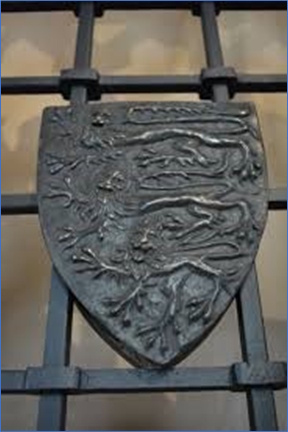
If you live in Tewkesbury you are incredibly lucky. The Abbey,[4] founded in 1087 is second only to Westminster Abbey in the number of medieval monuments it contains. Each tells a story and has its own niche in history. Located behind the High Altar of Tewkesbury Abbey, close to the Beauchamp Chapel, is the Clarence Vault. Hidden from view, beneath a metal grille in the floor, it is inaccessible to the public. There are no inscriptions above it and no effigies to memorialise its occupants.
The vault is said to house the remains of George, Duke of Clarence and those of his wife, Isabel Neville, daughter of Warwick the Kingmaker, but is this true?
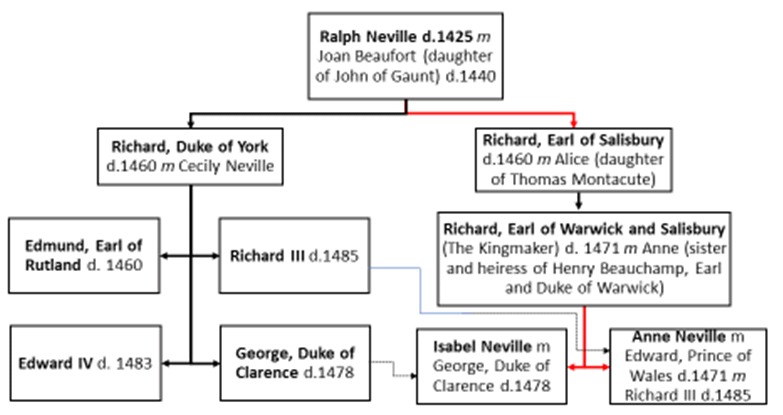
The first question one might ask is why was Tewkesbury Abbey chosen for their internment and not Warwick or London? George received the Manor of Tewkesbury when he married Isabel. The Manor had passed down through the Beauchamp family until the absence of male heirs resulted in the estate passing to Anne Beauchamp, Isabel’s Mother.
The Death of Isabel Neville
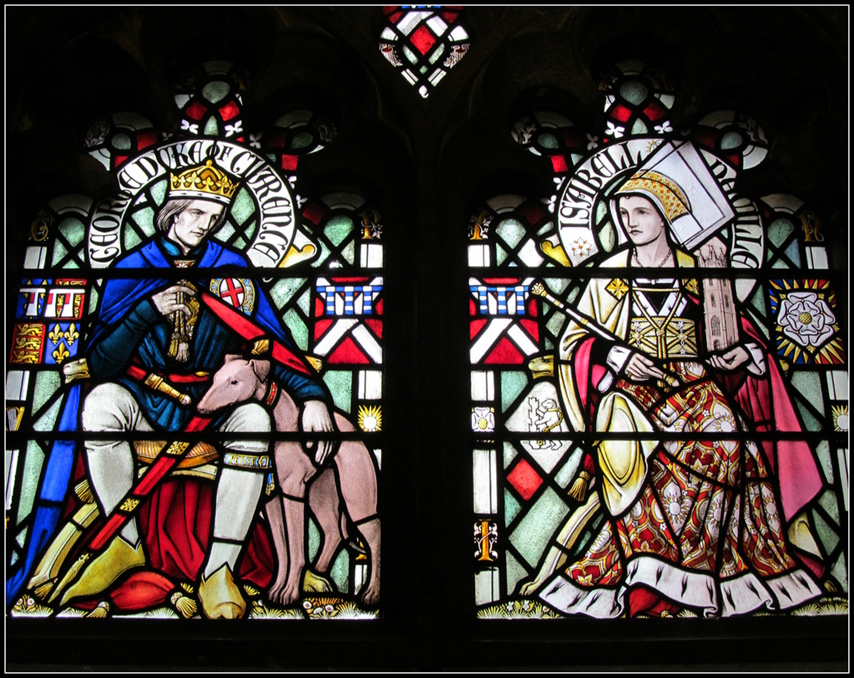
stained glass at Cardiff Castle
[courtesy of Thorns of Time
– an historical blog]Click Image
to Expand
On 22 December 1476, just two and a half months after giving birth to her fourth child Richard in the Benedictine Infirmary of Tewkesbury Abbey, Isabel Neville passed away at Warwick. Her death has since been attributed to childbed fever, a bacterial infection or consumption. A noblewoman of Isabel’s status would normally have given birth in her own home, so the choice of Tewkesbury for her ‘lying in’ perhaps indicates that she had been already struggling with ill health in the later stages of her pregnancy.
Following her death, Isabel’s body was embalmed using salt and spices and wrapped in cerecloth (cloth coated with wax) before being sealed into a lead shell. This lead shell was then placed inside a wooden coffin before being brought back to Tewkesbury from Warwick and laid upon a hearse inside the choir of the abbey for thirty-five days.
The popular view is that the vault was being prepared during this time. It was sited opposite the Lady Chapel (sadly destroyed during the dissolution of the monasteries). The vault was dug out of the abbey floor and given an arched roof, while its walls were lined with stone. The floor was tiled.
Isabel was only 25 when she died. This was not considered young for the times. During the Middle Ages a woman’s life expectancy which typically fell between the ages of fourteen and forty (child bearing years) was half that of men. Nevertheless, George was so overcome with grief by her loss he became convinced that his wife had been poisoned by one of Isabel’s ladies in waiting, Ankarette Twynho, who was arrested and tried for her murder at Warwick. Sadly, for Ankarette the outcome of the trial was a foregone conclusion and under George’s direction she was hanged in April 1477.
Her summary execution marked the beginning of the end for George. Ankarette’s son complained to the King who subsequently issued a pardon clearing her of all charges. George, somewhat predictably, reacted badly to this decision and his behaviour from this point onwards became increasingly erratic and ill-judged.
With what seems like indecent haste by modern day standards he decided to marry the recently widowed Mary, Duchess of Burgundy, but the King, wary of his brother’s ambition, would not sanction the match and a disaffected Clarence left the Court.
The Death of George, Duke of Clarence
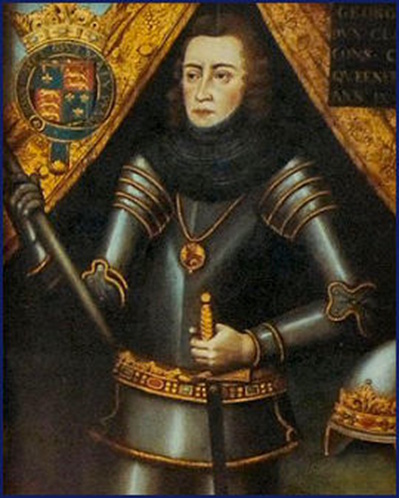
[Lucas Cornelisz, Dutch Renaissance
painter of the Tudor Court]
Following the arrest and execution of two of Clarence’s retainers, Clarence was summoned to court and accused of treason by the King. Parliament passed a Bill of Attainder[5] against him and he was imprisoned in the Tower of London until his trial. Found guilty of treason against Edward IV[6] he was privately executed in the tower on 18 February 1478. Legend has it that he was drowned in a butt of malmsey wine[7] before being removed and having his throat cut.
The Tudors used George’s execution to further smear the reputation of his brother, Richard III. In his play, Richard III, Shakespeare has Clarence recall a dream in which Richard knocks him overboard whilst at sea and he drowns. When Clarence’s executioners arrive in real life, we are told they are in the pay of Richard:
A shadow like an angel, with bright hair
Dabbled in blood; and he squeak'd out aloud,
'Clarence is come; false, fleeting, perjured Clarence’
(William Shakespeare - Richard III, Act 1, Scene 4) [8]
Contemporary historians still debate whether George was executed by drowning, but a portrait of George’s daughter, Margaret, Countess of Salisbury, shows her wearing a charm bracelet with a barrel attached. So, this may be a relevant clue.[9]
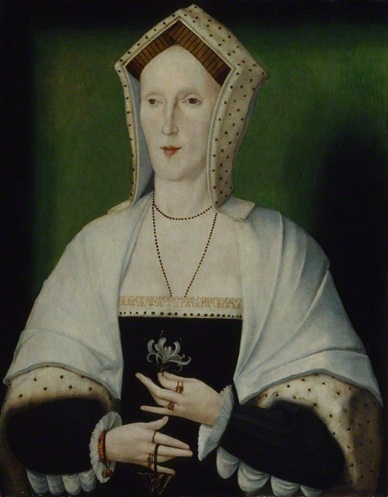
Countess of SalisburyClick Image
to Expand
Despite his violent end, the King arranged for Clarence’s body to be taken to Tewkesbury for burial. His cortege left London shortly after his embalmment and was accompanied on the 125-mile journey by various unnamed lords, one of whom could conceivably have been his brother, Richard. When the body of their former patron reached Tewkesbury the Benedictine monks would have performed the office of vespers for the dead that same evening followed by matins the next day. His internment is said to have taken place on 25 February. His body would have been carried from the choir and laid beside that of his wife in the Clarence Vault.
In 1826 the Gentleman’s Magazine[10] records the presence of a large blue stone covering the vault which bore traces of inset brasses that had once been present. Today, this stone’s whereabouts are unknown, but it is interesting to note that it could have been provided together with the brasses, at the behest of Richard. In 1483, records show that he visited Tewkesbury Abbey and settled his late brother’s debts with the monastery. The blue stone sounds very similar to that recorded as being laid above the body of Richard’s wife, Anne Neville, (Isabel’s sister) in Westminster Abbey
The Hawley Burials
Following their separate internments, the tragic couple should have lain undisturbed from then on, but fate had other plans. In 1709 the tomb was reopened to allow the burial of a local Alderman, Samuel Hawling of Tewkesbury Corporation. Two decades later, in 1729, it was opened once more to allow the body of Samuel’s widow, Mary Hawling also to be entombed. Adding further insult to injury, in 1753 the vault also received the body of the couple’s son, John Hawling. The Gentleman’s Magazine published in 1826 took a dim view of these burials as evidenced by their acerbic summary below.
Samuel Hawling was bailiff of the Borough in 1677, and John Hawling served the same office five times; but could not these “periwig-pated aldermen” find some other spot, within this sacred temple, where their bones might rest in peace, without desiring to commingle them with those of individuals alike distinguished for their rank and their misfortunes?
The Clarence Vault measured 9ft by 8ft so needed some rearrangement to allow the internment of three further bodies. If still present, George’s and Isabel’s remains would most likely have needed to be repositioned in 1709 and indeed again in 1753. But the suspicion is that the bodies of George and Isabel had not been left undisturbed. If this is the case, there are two rival theories for what might have happened:
During the dissolution of the monasteries the townsfolk of Tewkesbury raised £453 to prevent their abbey from being literally ruined. This sum (huge for the time) equated to the value of the lead on the roof and the bells. While the main abbey church was saved, adjacent structures including the Lady Chapel; cloister complex and other buildings were removed. Although there is no written evidence to prove that the tomb was entered at this time it does seem likely that workmen could have accessed the vault, particularly given its proximity to the Lady Chapel. The Tudor regime they were working for had no love for the Plantagenet dynasty (Henry VIII’s Father, Henry VII, had killed the last Plantagenet king, George’s brother Richard in August 1485) and were proven revisionists when it came to recalling the recent past. George and Isabel’s grave goods would have proved tempting for those reeking destruction above them. The anthropomorphic lead shells their bodies had been sealed in represented money for the King’s commissioners. If they were removed during the dissolution then their remains may have been skeletal and therefore the Hawley builders would have been able to just put the bones to one side while preparing the vault.
Alternatively, the vault might have been accessed during the commonwealth period when England was ruled as a republic (1649-1660) following the death of Charles I and the end of the English Civil War.
When Samuel Hawling’s body was laid to rest inside the vault in 1709, builders created supports to elevate his remains from the floor as it appeared the vault was prone to flooding. Further remodelling was undertaken in 1729 when a shelf was constructed above Samuel’s remains to support the body of Mary Hawling. In 1753, when John Hawling was laid in the vault, its floor was coated in pitch in an attempt to waterproof it.
Examination of the Bones
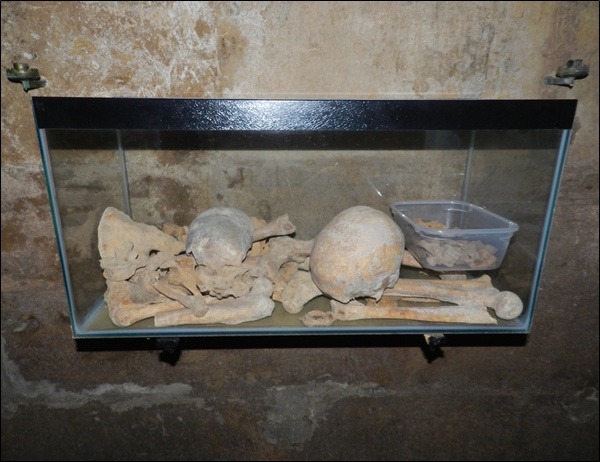
to Expand
In June 1982, the bones were removed from the vault and examined in the presence of the vicar, Reverend Michael Moxon.[12] They were listed and photographed, but no further tests were carried out. Findings tentatively suggested that they belonged to a male and female. When the bones were measured however, the height and age profiles of the remains did not appear to match those of George and Isabel. The male remains were said to be those of a man measuring 5ft 3inches, aged between 40 and 60+ at date of death (the reader must bear in mind that George’s brother, King Edward IV was said to be approximately 6ft and Richard III’s remains show that he was approximately 5ft 8, even with scoliosis of the spine). The female remains were described as showing arthritic changes and said to be those of a woman aged between 50 and 70+ at date of death. Where then, were George and Isabel?
The last time the remains were examined, in April 2013, Dr. Joyce Filer discovered that there appeared to be bones of more than two individuals contained in the glass and metal box inside the Clarence Vault.[13] The majority of the bones appeared to bear out the findings of the 1982 examination discounting them as belonging to George and Isabel.
Dr. Filer determined that the male skull was that of a younger individual and had no connection with the other bones. It had a healed cut across the front which was consistent with a wound being suffered some years prior to death. George is said to have suffered a head wound at the Battle of Barnet (1471) so potentially this could have been his cranium. However, with no plans for DNA testing of the remains, at this point we cannot know with 100% certainty. Doctor Filer also found some tiny bone fragments belonging to another female. These remains suggest a woman of slender build who died in her twenties. They may or may not belong to Isabel.
It has since been suggested the older bones could be those of William de la Zouch.[14] The 1st Baron Zouche was originally laid to rest in the adjacent Lady Chapel in February 1337 but when this was demolished his bones would have needed to be relocated. Given the Clarence vault’s proximity to the Chapel it seems quite probable that they would have been placed in there. William de la Zouche was in his 50’s when he died so he would fit the age profile of the bones given in both examinations. William’s wife, Eleanor de Clare (Despenser) was laid to rest next to him in the Lady Chapel, but the age profile of the bones indicates that her remains are not amongst those in the Clarence Vault. Eleanor was 45 when she died – younger than the 50-70+ age range that has been ascribed to the female relics, present.
The mystery it seems, is set to run for some time yet. In the meantime, one can only hope that wherever their remains are in the physical world, George and Isabel may finally have found peace in the next.

APRIL IRWIN lives in the North West of England and works as a Neighbourhood Manager, managing social housing properties in South Manchester. When not working, she has a variety of pastimes including reading, creative writing and volunteering in the local community. She is particularly interested in history and enjoys visiting castles, churches and other scheduled monuments. The Plantagenet and Tudor eras have always captured her imagination and having family members who live in Tewkesbury has given her many opportunities over the years to explore the local area and visit the magnificent abbey.
References
- https://www.archaeology.co.uk/articles/news/found-the-lost-church-where-richard-iii-was-buried.htm
- https://www.englishmonarchs.co.uk/plantagenet_18.htm
- http://www.philippagregory.com/family-tree/george-duke-of-clarence [dead]
- Morris, Richard K & Shoesmith, Ron (Eds.) (2003), Tewkesbury Abbey – History, Art and Architecture. Logaston.
- https://tudorhistory.org/glossaries/a/attainder.html
- https://en.wikisource.org/wiki/Page:Cassell%27s_Illustrated_History_of_England_vol_2.djvu/28
- https://meanderingthroughtime.weebly.com/history-blog/-george-duke-of-clarence-a-sad-end-to-a-sorry-tale
- http://www.monologuearchive.com/s/shakespeare_047.html [dead]
- https://www.thecrownchronicles.co.uk/history/history-posts/historys-strangest-deaths-george-duke-of-clarence-drowned-in-a-barrel-of-wine/ [accessed Oct 2018]; Vidal, Elena Maria – The Butt of Malmsey (2013) https://teaattrianon.blogspot.com/2013/03/the-butt-of-malmsey.html [Nov 2018]
- Gentleman’s Magazine (1826), Volume 96, Part 1; Volume 139.
- Ashdown-Hill, John (2014) The Third Plantagenet – George, Duke of Clarence, Richard III’s Brother.
- https://erenow.com/biographies/the-third-plantagenet-george-duke-of-clarence-richard-iii-brother/17.html [dead]
- https://erenow.com/biographies/the-third-plantagenet-george-duke-of-clarence-richard-iii-brother/18.html [dead]
- Bennett, James (transcriptions by Lockie, Rosemary) ‘Distinguished Persons buried at Tewkesbury, who have no Monuments’ (2015) https://texts.wishful-thinking.org.uk/Tewkesbury1830/DistinguishedPersons.html [Nov 2018]
Comments