The Railway Comes to Tewkesbury 1830-1845
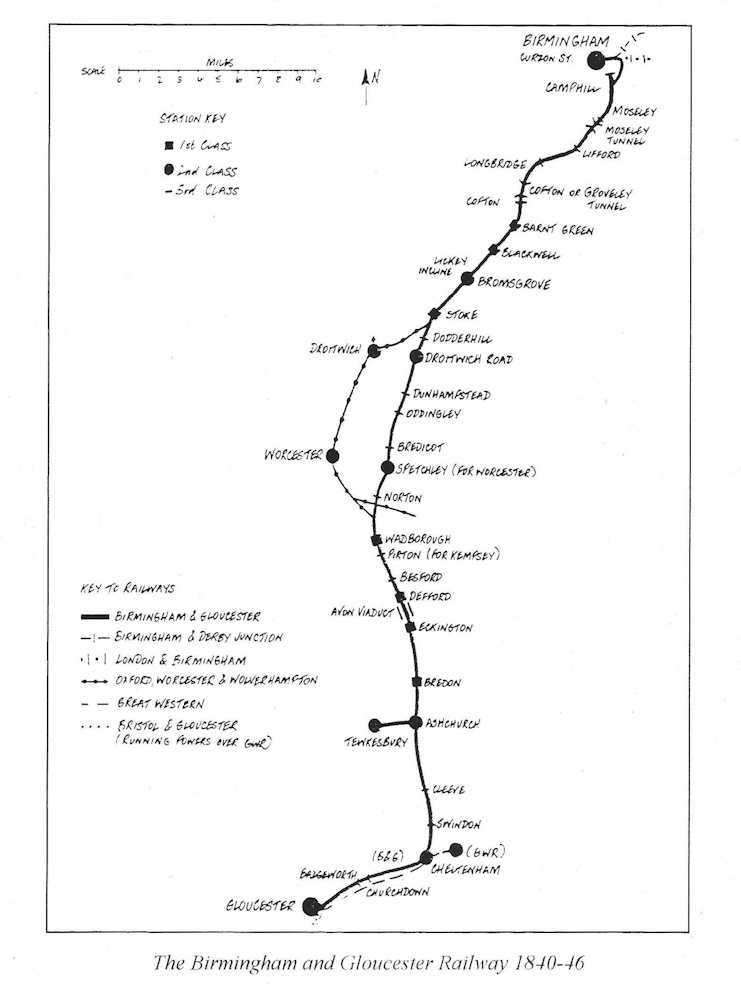
This article will describe that part of the history of the Birmingham & Gloucester Railway which affected Tewkesbury and the surrounding area. It will finish in about 1845 when the railway was absorbed into the Midland Railway, based at Derby. There will be little reference to the line to Malvern but it will concentrate on the original branch line. The discussion will focus upon the situation regarding railway proposals as they affected Cheltenham and Worcester, as they play an important part in the story and, at certain points, other examples from rival contemporary railway ventures will be considered. Thus we shall investigate how far the railway to Tewkesbury changed people’s lives. In the long term it was usually for the better but in the short term it could be argued that Tewkesbury fared for the worse. The author finds himself, objectively, on the side of a shareholder of the Railway rather than a citizen of Tewkesbury.
Until 200 years ago most people were limited to how far they could travel in a day, either on foot or on horseback. This would be about fifteen miles. The stagecoach should have opened things up but the roads were in very bad condition until they were improved under the Turnpike Trusts. Stagecoaches were, however, far too expensive for the ordinary person. The canal era beginning in 1760 did improve the carriage of goods but it was very slow so few passengers were carried. However, you could travel from Tewkesbury to London by river and canal, by taking a Severn Trow on a Friday to Worcester and then a canal boat owned by Messrs. Pickfords to London. The trip must have taken days. It was also probably possible to get there using the Severn & Thames Canal through Stroud, Oxford and Reading. The canals began to open up the countryside but there were areas of the Cotswolds that had to wait until the omnibus liberated them in the early days of the twentieth century.
Around 1800, limestone was already being quarried on Leckhampton Hill and transported into Cheltenham. A Parliamentary Bill was passed in 1809 for a horse-drawn railway from Cheltenham to Gloucester, with a branch line up Leckhampton Hill. The route up the hill opened first in July 1810 and the line to Gloucester opened a year later and, although it suffered financial difficulties, it was competitive with the railway in the early days and survived to the late 1850s.
The rapid growth of industry in the Birmingham area at the end of the 18th century required merchants to get their goods distributed to as wide a market as possible, including shipments overseas. About 1800 the river Severn was very difficult to navigate, particularly south of Gloucester, but it was another forty years before there was a concerted effort to improve the depth of water above Gloucester. After decades of trials and tribulations the Sharpness Canal was opened in 1827 so that ocean-going ships could reach Gloucester.
In 1824 the alternative idea of linking Bristol and Birmingham by railway started to take shape with an initial survey suggesting a line from Gloucester through Tewkesbury, east of Worcester and on to Droitwich. The idea was revived in 1829 and 1830 when the young Isambard Kingdom Brunel surveyed the route. There was a stipulation that it was to be a direct line avoiding centres of population with their inflated land values. The route chosen by Brunel went much further east, going from Gloucester straight to near Evesham and on to Redditch, which would have cut out Tewkesbury completely. Brunel was a master of avoiding steep gradients, which can be seen today with his route from Reading to Swindon up the Thames valley and skirting to the north and west of the Berkshire Downs. The line proposed by Brunel was too expensive and all the towns were bypassed. In the long run it might have been the best solution as the eventual route involved the extremely steep incline up the Lickey Hills which was very costly to operate. They really ought to have listened to Brunel, who was paid £100 and was sent packing to make his name elsewhere. Worcester, Tewkesbury and Cheltenham were not at all happy at being bypassed and made their position very clear.
There was then a proposal by the Cambrian, Gloucester, Birmingham & London Railway, which would have gone through Tewkesbury. The plan I have seen suggests the route actually went well to the west of Tewkesbury. Their rivals, the Birmingham & Gloucester Railway, appointed Captain M. S. Moorsom to survey a route. He had had ten years’ military service in which he specialised in surveying and then some experience with the London & Birmingham Railway. His route avoided the main towns but came much nearer Tewkesbury and he was paid £500 for his efforts. At that time military men were the only ones with experience of handling the large number of men required to build any railway. In June 1835 the Worcester Journal, for obvious reasons, preferred a line going through various towns.
With the benefit of hindsight, one now looks more favourably upon the argument of the surveyors regarding Tewkesbury compared with the local commentators of the day. Even today the centre of Tewkesbury on a in surveying and then some experience with the London & Birmingham Railway. His route avoided the main towns but came much nearer Tewkesbury and he was paid £500 for his efforts. At that time military men were the only ones with experience of handling the large number of men required to build any railway. In June 1835 the Worcester Journal, for obvious reasons, preferred a line going through various towns.
With the benefit of hindsight, one now looks more favourably upon the argument of the surveyors regarding Tewkesbury compared with the local commentators of the day. Even today the centre of Tewkesbury on a bad day in winter is surrounded by water, and indications are that the flooding problem was much worse 150 years ago. To build a satisfactory north-to-south railway line through the town would have required considerable earthworks, brick arches and bridges to keep the level of the line above the flood plain but keep the Swilgate and Carrant Brook flowing.
Captain Moorsom’s plan was approved in September 1835 and a prospectus was issued inviting people to buy shares. This was the start of our railway. The prospectus had some very promising details of the rapid growth of Gloucester Docks and the fact that boats took several days to get from Birmingham to Gloucester but the railway would only take a few hours. Also canal and river traffic was delayed in winter and when the water levels were particularly low. At this stage Cheltenham was going to be bypassed, the line going from Gloucester to Mauds Elm (near the present ‘B&Q’ supermarket) and then on to Stoke Orchard. There were furious protests about avoiding towns, particularly from the Cheltenham direction. After all, they did have their tramway and the embryonic Cheltenham & Great Western Union Railway, who were advised by none other than Brunel. So after some bargaining a modification was incorporated to include this projected railway. The line uses some of the old Cheltenham Tramway, particularly entering Gloucester, and the sharp curve at Lansdown Station marks the end of the old Tramway section; there would then be a piece of line to connect up with the original proposed route near Mauds Elm. The railway did not go nearer the town centre than about a mile because it was too expensive to buy the necessary property and demolish it for the new line.
Worcester people were still complaining bitterly that the proposed railway missed their town when the Bill was introduced to Parliament in February 1836. They handled these developments poorly compared with the Tewkesbury approach and bear some of the blame for not obtaining a railway station until 1850.
Tewkesbury citizens were among the opponents to the Bill so on 16th February a public meeting was held, called by the Mayor, when a petition to Parliament was adopted without a dissenting voice. The petition said that if the Bill was passed ‘an extensive and irreparable injury will be done to the traffic, trade and property of the town.’ It goes on to say ‘it was originally intended ... to take the direct route to the latter place (Birmingham) thus passing by the town of Tewkesbury and they distinctly assert such line be the most direct, the least expensive and best.’ They wanted a Parliamentary surveyor or engineer to be appointed to inspect the line and suggest such ‘alterations and improvements as may seem expedient with the view that local interests be not impaired and the value of property depreciated by railways, in many cases to the total ruin of the owners of such property.’ On the following day, William Dowdeswell presented the petition to Parliament. There was a second meeting on 22nd February when they decided to present another petition. Mr. G. E. Williams and Mr. John Moore were delegated to proceed to London in order to take any necessary further measures. This petition was seven yards in length, with double rows of names and descriptions!
Tewkesbury had, indeed, much to lose by this development. Tewkesbury possessed a thriving coaching industry, which was threatened with extinction. There was the Stow to Hereford route that went over Thomas Telford’s new bridge at the Mythe; there was the route from Gloucester to Worcester, and routes up the banks of the Avon towards Birmingham. The area around the Cross must have been a comparative hive of activity in those days, with about thirty coaches a day, and the inns and hotels are still there today. In practice this trade would have been lost irrespective of whether the railway came to Tewkesbury. There was some additional short-distance coach traffic from the new railway station into town. The lack of coach traffic reduced the Turnpike revenue so the state of the roads deteriorated again.
Preliminary work on the main line began in the early months of 1836, with a five-year target for finishing the engineering work. The Management optimistically thought it could be opened two years after the letting of the first construction contract. This was ‘Railway Mania’ – the boom time for the construction of railways with optimism abounding. One of the canal booms collapsed in 1796 leaving the Coombe Hill Canal unfinished, but the Tewkesbury branch was finished well before the railway boom collapsed in 1845.
Our little branch was planned to depart from the main line at Ashchurch and come through the town to a fine station at right-angles to the High Street, with a link to the Quay on the Mill Avon. At Birmingham & Gloucester Railway’s Annual General Meeting in 1836 the audience were told the branch would secure the transport of coals, goods and merchandise from Tewkesbury along the main line. In practice, they would be in competition for the all-important coal traffic from the Forest of Dean and the Midlands with the Coombe Hill Canal. Furthermore, goods came to Cheltenham from Gloucester along the tramway and later the railway. It appears that there was a Tewkesbury representative on the board of the Birmingham & Gloucester Railway in 1837. Added to this, there was a period of monetary difficulty in 1837 with the consequent inability of some shareholders to meet the calls on their shares. The Birmingham & Gloucester Railway Company were always short of money. In addition, they were unsure of Captain Moorsom’s plans and obtained a second opinion. Messrs. Sproule and John Moore were appointed to watch the progress of the Bill and did succeed in getting a clause inserted bringing the branch from Ashchurch to the Quay. The Railway Company split the contracts into various sections, the local ones being Cheltenham, Bredon and Eckington. They divided these contracts into various parts depending on the trade involved, earthwork, masonry, iron and fencing, so that the contracts could be let out to parties more conversant with each description of work.
It appears that work actually began in November 1837 but the shares had slumped to a 70% discount. The local report for the year said ‘The railway is the direct and only line of communication between the north and the west of England’ and that it was thought the line could be completed without borrowing any money from the banks. This proved to have been a very optimistic projection.
Building work at the Tewkesbury Depot had commenced in the latter part of 1838, with building materials being delivered by river to Tewkesbury Quay. By February 1839 the whole project was running well over budget, as land in the Birmingham area was costing twice the budgeted figure. Incidentally, Ashchurch Station cost £379.
Additionally, there were civil engineering difficulties including the wing walls of the Avon Bridge at Eckington giving way and presumably having to be rebuilt. There was also a little local difficulty. There was not only an Act of Parliament but also a written agreement between the railway company and influential townspeople over the link to the Quay. In 1838, a deputation of Messrs. Sproule, Vernon and Bennett met the directors at Worcester on 27th March to urge them to the performance of the spirit of the agreement. They stressed the injury that the town and railway company would sustain if the branch were not carried to the river. Captain Moorsom and several directors came to Tewkesbury on 9th June, looked at the cost of extending the line and the returns received, and agreed to give the matter serious consideration. The change of plans from a station on the Quay to one on the High Street was based upon the company’s need to control costs. The link to the Quay was only built as things improved.
to Expand
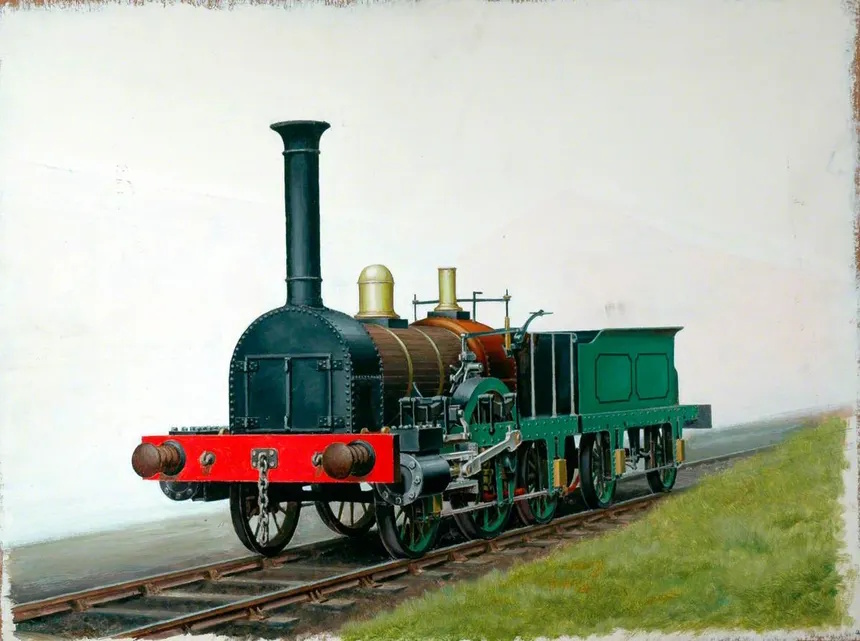
It appears that a locomotive had been used in the construction of the line between Cheltenham and Tewkesbury. The Cheltenham Examiner reported trials between Cheltenham and Eckington in May 1840 with a loaded train of 100 tons, and on one day there were two locomotives present. One might wonder how they arrived there when there was no connecting track. One of these locomotives could have been the ‘Excavator,’ which arrived in Cheltenham in July 1839 on a wagon drawn by twelve horses – it must have been quite a sight as it weighed 11 or 12 tons. There were also some ‘Forrester’ locomotives on the line at the time, which were very badly treated by the contractors.
On 30th May a single line from Cheltenham to Bromsgrove was complete and a private train of two carriages and four wagons ran for two days. The directors went up the line to be met by an excellent band provided by one of the contractors. There were flags and banners: a further five carriages joined the train at Ashchurch on the way back. This was thought by some to have been the official opening of the line. In fact, history records that this took place on 24th June 1840 without due ceremony as the management were probably concerned over the costs involved[2]. Apparently a locomotive-hauled train conveyed spectators from Tewkesbury to see the first train go through Ashchurch. It must have been an incredible sight. This first train on the Birmingham & Gloucester Railway left Cheltenham at 9.10am with a bugler playing ‘God Save the Queen.’ The signal for starting was given and the train set off in gallant style, quickly receding from the astonished gaze of the persons assembled. The pace was excellent, being at least 30 miles an hour. After passing Ashchurch the train arrived at Eckington and then stopped at Defford, where it was crammed to capacity. It reached Spetchley at 10.50am, where a connecting coach and horses were waiting for Worcester passengers. Here it took on water, then went on to Bromsgrove where things were very unfinished. The locomotive turned round, getting back to Cheltenham at 12.27pm. This success made the shares soar that day from £62 each to £75, so at that point they had a small loss after nearly four years. The railway had spent all its capital and had borrowed about £330,000[3], as the Cheltenham to Gloucester section had cost them much more than they had bargained for. The line was open to Gloucester in November 1840 and as far north as Birmingham in December 1840.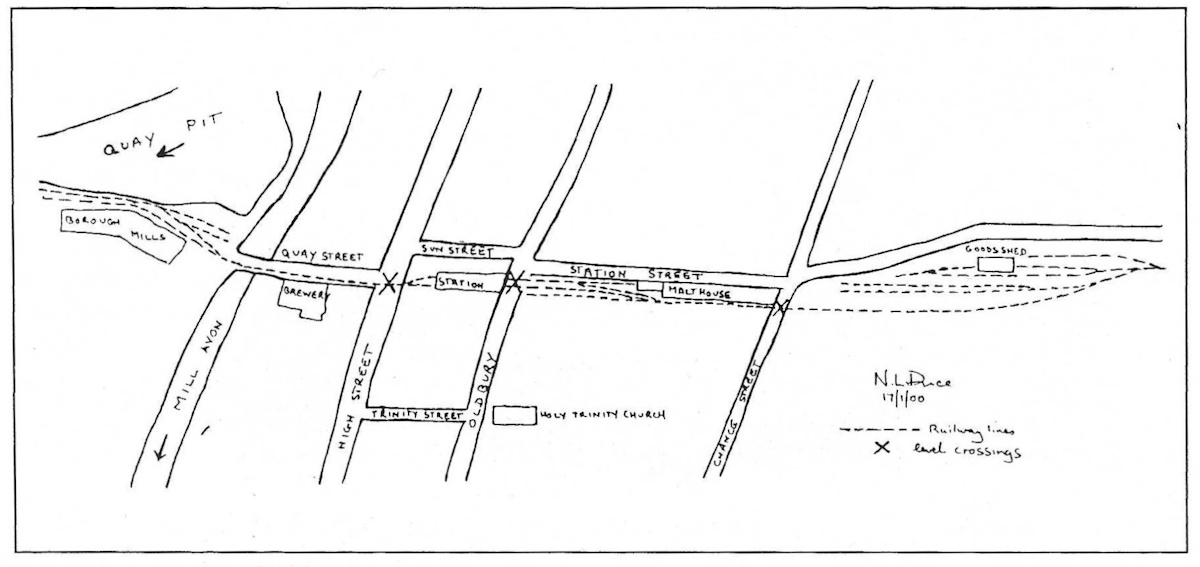
The Tewkesbury Branch, however, was two miles and nine chains long. The route left Ashchurch Station on a curve and it was a relatively flat line with one or two level crossings and a bridge or two for the first one and a half miles. Just before the location of the Tewkesbury Station of more recent memory, and by the site of the modern Baptist Church, the line covered the southern side of an area that was to become the goods yard over the next twenty-five years. It then crossed Chance Street by way of a level crossing and the two lines came down to one line to squeeze through a small gap between ‘Downings Maltings’ on the north side and allotments on the south side. It then opened out into a yard where there was an engine-shed built in red brick picked out with blue brick, and a small water tower. High brick walls, some of which appear to have survived but are now only 4ft high, surrounded this yard. The Branch then traversed another level crossing and entered the Station. Because of all these level crossings, there was an unexpected clause in the Act of Parliament stipulating that locomotives were forbidden on the branch line as the public needed to be protected. This rule does not appear to have been obeyed for very long and locomotives, apart from horse-drawn night mails, hauled all traffic from February 1844.[4]
There was uproar, however, when it was found that the railway company had no intention of taking the line to the Quay in the initial stages. This was strange as the line needed as much goods traffic as possible. The railway company offered a lease of the whole line from the Quay to Ashchurch for 20 years at 5% on the building cost: that is to say, they would receive their money back and the branch line after 20 years. No one in Tewkesbury took up the offer. The Council and the railway company eventually shared the expense of extending the line, knocking down one side of Quay Street, opening around 1844 some four years late. Today, looking down Quay Street from the other side of the High Street, behind the premises of ‘Tewkesbury Taxis’ one can see how adjoining buildings were demolished, with strengthening buttresses put in place. It appears only one line went across the High Street but it broadened out to two tracks in Quay Street and then down to one line over its own little bridge over the Avon: it again broadened out in the Borough Mills complex. A maximum of six wagons was allowed to be hauled up the incline by horses. In addition to the Mills, the line served ‘Rice & Co.,’ ‘Tewkesbury Brewery’ and any traffic generated by the river.
The Tewkesbury Examiner described the station on the east side of the High Street as built of ‘Postlip freestone, 38 foot in length and 34 foot in height.’ It had a fine Gothic screenwork front with oriel windows and battlements. In the centre of the building were two well-proportioned gateways each 12 foot high and 12 foot wide, one for passengers and the other for passengers and goods. The extension to the Quay would go through these. Probably only the more northern gateway was used. There were suitable offices on the ground floor with cellaring underneath, and four airy upper rooms on the ground floor forming a comfortable residence. Stone stairs led to a light, spacious booking office. There was a single long paved platform beneath a substantial roof, which was surmounted by an exterior roof spanning 40 feet and upwards of 160 feet long. So the whole station was about 200 feet long – the equivalent of two modern coaches and a small locomotive. It is calculated that the depot, station, house and offices cost the railway little less than £10,000.[5] The Railway Times found that the station added much as an ornamental building to the High Street and reflected great credit on the builder, Mr. F. P. Holder. The length of wall between modern ‘Tescos’ and ‘Kwiksave’ is the only part of the station left.
A Chief Clerk, who may have employed a clerk and a porter, ran the station. They were all under the supervision of an Inspector. There were at least four Chief Clerks at Tewkesbury – William Pengelly, Daniel Heath, J. Dore and a Mr. Middleton. Tewkesbury may have been the place where errant staff were sent to be out of harm’s way. J. Dore had been responsible for a fatal accident on the main line at Defford; Anthony Foreman, a special constable at Cheltenham, was said to have been too drunk to report for duty in August 1842, so he was sent to Tewkesbury and Spetchley as a porter and, in both places, drink was his undoing.
There was one little operational snag – local time was used for the departure of trains and apparently there was 10-15 minutes’ difference between towns (national time was not adopted until about 1856). At Gloucester Station there were three clocks giving London, Birmingham and Gloucester times. Only light traffic was expected and a local carrier, Mr. Trotman, was approached to work the Branch with horse and carriage, remembering that locomotives were theoretically not allowed to work on the line. The original railway carriage, a development of the stagecoach, was divided into two compartments for first and second class passengers, with the third class passengers riding outside. Mr. Trotman was to meet each passenger and mail train at Ashchurch. It is said the cost to the railway for this piece of subcontracting was £280 in 1842. It is believed that Mr. Trotman also delivered small goods and parcels round the town. This arrangement continued until February 1844 when more regular steam trains began.
With the railway now built it was time to consider how to operate it. Humphrey Brown, the owner of a Tewkesbury Water Transport business, applied for the vacant post of Secretary, being backed by 124 shareholders, but Captain Moorsom rejected this. Later, as head of the goods department, he saw himself as a saviour, wanting the company to set up as sole carriers and actively competing with road and water transport.
Tewkesbury merchants complained bitterly that they were originally encouraged to set up a corn and coal trade to Cheltenham from the Quay. However, the rates had quadrupled from 1s.6d. (7p) a ton to 6s. (30p) a ton, while some goods went all the way from Cheltenham to Birmingham for only 4s. (20p). The tolls were set by Parliament and it appeared the rates charged from Tewkesbury contravened the law so that the company could concentrate on traffic on the main line. An 1838 report had said that coal could be economically carried from Tewkesbury. However, they later changed that opinion: it would not be economic, possibly because there were few return loads.
On the main line, a Mr. Williams of Cheltenham purchased his own fleet of coal wagons to offload coal at Eckington, Bredon and Ashchurch, and apparently flourished. The coal traffic to Cheltenham was enormous at this time, some 90,000 to 100,000 tons a year, of which the gas works took 58,000 tons in 1837. Half this coal came from the Forest of Dean and half from the Midlands. The Directors, perhaps inspired by the Quaker in their midst, resolved not to have trains on Sundays except for mail trains and, despite opposition, this prevailed for many years.
The first serious accident involving a train happened on our branch on May Day 1840 when a ballast wagon hauled by the locomotive ‘Worcester’ was near the station. The driver decided to run off the steam, let water into the boiler and coast into the depot. There was a wagon on the line ahead and, as he had no steam, he could not stop and collided with the wagon. There were six or eight men on the tender who were injured but another two in a wagon in front of the engine were killed. The driver was found to be drunk and was subsequently charged with manslaughter. There were many accidents to railway employees but only one passenger was killed in the first few years of operations.
(The Illustrated London News)Click Image
to Expand
Shareholders also found themselves among the casualties. Shares plunged to a 60% discount in February 1842 as the cost of the railway soared to £1,450,000[6], some £500,000 over the original budget. They had been sold some inferior locomotives, which needed extensive modification before they worked satisfactorily.
In early 1843 the shares had improved but shareholders had lost confidence in the Directors, so a Committee of Enquiry was set up. After some staff had been dismissed or had their pay cut, and a sensible productivity bonus scheme for engine drivers had been introduced, the cost of operating the locomotives improved. As they gained more experience, things did improve and a small dividend was announced. At this time, no expenditure was allowed unless it was in the interests of economy.
Captain Moorsom left the Railway Company in December 1843 and went to another railway at Southampton, dying in 1863 after a long illness. The determined Humphrey Brown talked himself into the job of traffic manager, declaring that he would work without profit until a dividend of 3% had been achieved. Eventually he had to resign, however, because of his rudeness to a customer.
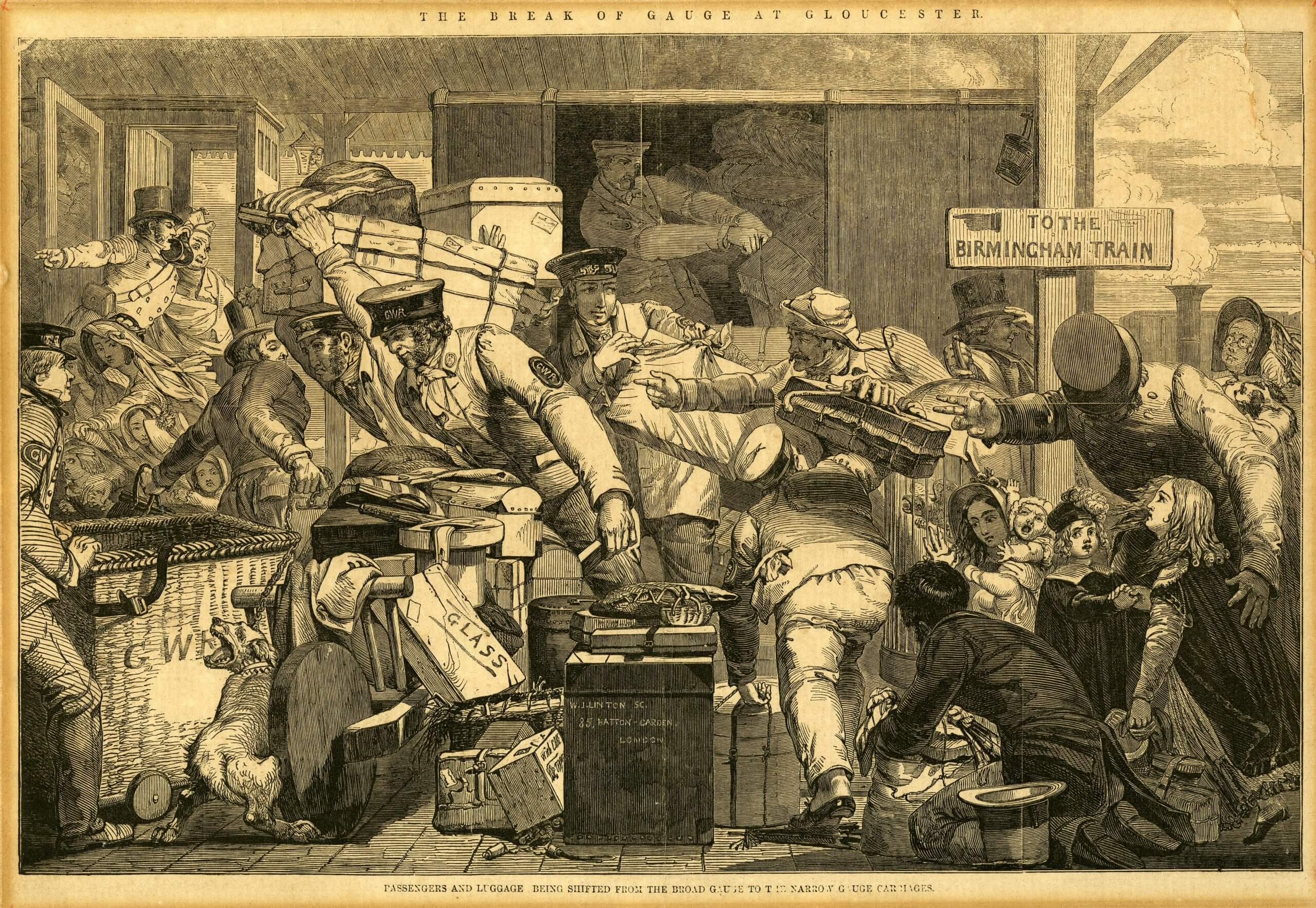
In 1844 things really did improve: there was a temporary connection to Gloucester Docks and to Tewkesbury Quay, and the vital connecting link from Gloucester to Bristol opened in July. As the Bristol line was broad gauge (7 ft 0¼ inches) and the Birmingham line was standard gauge (4 ft 8¾ inches) all goods and passengers had to change train, with much confusion and chaos.[7] These two lines linking Birmingham and Bristol signed an agreement to merge in January 1845, despite the difference in gauges, as a prelude to getting the necessary Act of Parliament passed.Then in early 1845 the Great Western Railway suggested an amalgamation but did not offer enough. The directors turned to the Midland Railway, who agreed to take on all the liabilities and lease the line for 18 years at 6% of cost. The shares rose to £133, only a 33% premium after nine years of struggle. The Midland Railway took full control in August 1846 until 1923, when the Midland Railway was merged into the London, Midland & Scottish Railway (L.M.S.).
The goods traffic was rising quite fast in the first half of 1845 with 400-500 wagons in operation. In May 1845 the Great Western Railway opened the line from Swindon to Gloucester via the Stroud Valley. One commercial venture brought rail passengers to Tewkesbury – the races on the Ham, for which excursion trains came from Gloucester and Cheltenham: up to 2,000 are said to have come this way. In July 1843, however, an excursion overran Tewkesbury Station passing through one of the arches onto the High Street and hitting scaffolding which was on the arch. The scaffolding fell down, the train crossed the High Street killing an unfortunate pig, but the train did stop before reaching (plunging into?) the Avon. In a similar incident, passengers are said to have jumped off into a muddy Quay Lane. There were excursions to Birmingham in 1841 and Bristol in 1844 organised by the Gloucester Mechanics Institute: 623 passengers went on the Birmingham trip, which was decidedly over-ambitious. The Bristol trip was run just after that line was opened and there were bound to be problems. They were shabbily treated by railway staff on the way there – on the way back there was a two-hour delay at Gloucester and then a further delay at Cheltenham, so the Worcester contingent only got home at 3am.
Thus, after all its initial problems, the Tewkesbury Branch of the Midland Railway was quite well established. The fact that the main line did not come within two miles of Tewkesbury had a detrimental effect on its long-term future prosperity. Its growth was also badly affected by the transfer of the hosiery industry to Nottingham. However, many buildings were preserved which would have been knocked down to make way for a central station. Bennett’s Town Guide for 1860 includes: ‘Railways ... deprive inhabitants of that constant hustle and cheerfulness which the arrival and departure of post chaises and other passenger carriages created in the principal thoroughfares and especially in the vicinity of the chief posting houses.’
Even as early as 1845, the first proposals for an extension from Tewkesbury to Malvern were devised. These proposals failed in the Standing Orders Committee of the House of Commons and so it was nearly twenty years later, in 1864, that Tewkesbury obtained its link with Malvern through the independent Tewkesbury & Malvern Railway Company. This Company built a new Tewkesbury Station further from the centre of the town and the High Street station was closed. The line to Malvern was taken over by the Midland in 1877 – but that is another story.
Notes
- £13,219 in 1997 (Allan Robinson, June 1997 Bulletin of Lincolnshire Family History Society)
- Another source suggests our line did not open until 21st July.
- £11.5 million, in 1997 (Robinson, ibid.)
- However, it is believed that there were further periods of horse working.
- £411,000 in 1997 (Robinson, ibid.)
- £55m in 1997 (Robinson, ibid.)
- The etching from the Illustrated London News shows the difficulties encountered.
Bibliography
- P. J. Long and Rev. W. V. Awdry, The Birmingham & Gloucester Railway (Alan Sutton, 1987)
- Stephen Mourton, Steam Routes around Cheltenham (Runpast Publishing, 1993)
- Humphrey Household, Gloucestershire Railways in the Twenties (Alan Sutton, 1986)
- The Gloucester and Cheltenham Tramroad, Oakwood Press
- R. Pilgrim and D. F. Edwards, Cotswold Memories (Unicorn Books, 1990)
- Bennett’s Town Guide – various years
- Anthea Jones, Tewkesbury (Phillimore, 1987)
- Ordnance Survey Map 1886
Acknowledgements
‘Forrester 2-2-2 Locomotive’ (p.28) – Copyright: National Railway Museum/Science & Society Picture Library.
All the illustrations (apart from my map on p.29) are reproduced from ‘The Birmingham & Gloucester Railway,’ by kind permission of Sutton Publishing.
Author’s Note
Sun Street today is further north than the original Sun Street in the 1840s. Also, no photographs or engravings have been found showing the original Station frontage onto the High Street. Can anyone help?
Comments