
The Tewkesbury Census (W Snary)

The Decennial Census of Population was first instituted in England & Wales in 1801 and has continued to the present day, with the exception of 1941. Responsibility for the Census was with the Home Office until the Population Act of 1840 transferred it to the Registrar General, who headed a Census Commission which supervised the 1841 and 1851 Censuses.
The Census was initially designed to provide population statistics for the Government. Accordingly, the 1801-1831 returns were simply a numerical count carried out by parish overseers for the Home Office. In 1841, however, names and the relationships to head of household were included, while later Censuses contained other details such as place of birth, disability and occupation.
England and Wales had eleven Census Divisions and these had a number of administration districts, each with its own Superintendent Registrar. These districts were subdivided into Registration districts based on the boundaries of the Poor Law Unions, although later legislation realigned some boundaries to the County boundaries. The Registration Districts were further divided into Enumeration Districts and it is these Returns that the public can access subject to a 100-year closure period. The 1841 to 1891 information is currently available and the Public Record Office is planning to digitise 1901 Census returns and make them available electronically via the Internet in January 2002.
Enumerator returns for England and Wales, together with finding aids such as class lists, maps and street indexes for larger towns, are held on microfilm or microfiche in the Family Records Centre, London. However, local libraries usually have a copy of the films for their locality and often for neighbouring counties.
The Census was carried out by the Enumerator delivering schedules to each household before the census night and returning to collect them afterwards, completing any blanks himself by asking information of the householder at the time of collection. He then put the schedules in sequence, transcribed them into a book, wrote a boundary outline of the area covered, completed the statistic pages, and handed it to the Registrar for checking. The Registrar forwarded all the enumerator books to the Superintendent Registrar for further checking before the information was analysed. The books were then bound into folders five or six at a time. For filming purposes each sheet in the folder was given a folio number, resulting in every other page in the folder having a unique number in the top right-hand corner. This number is used as part of the reference when locating a specific schedule.
Census references consist of a Letter and Class code followed by a Piece number and Folio number:
- Letter and Class codes for 1841 and 1851 are HO 107
- Letter and Class codes for 1861 to 1901 are RG 9 to 13 respectively
- The Piece number is the relevant Enumerator folder
- The Folio number is the sheet within that folder.
Having located the required schedule, the accuracy of the information should be considered. We should envisage a nineteenth century enumerator in one of Tewkesbury’s notorious alleys asking questions of a child whose parents were usually ‘out’ to official-looking visitors. Would the child have known the age of parents or where brothers and sisters were born? Would correct information be given if a mother who, suspicious of the Government’s reason for wanting population statistics, feared eviction for overcrowding? She may have ‘lost’ one or two of her many children from the list of inhabitants. They may have appeared to live next-door for the purpose of the Census. Did older people say they were born in the parish for fear of being removed under Settlement Law if they fell on hard times?
There are further complications. Family ‘pet’ names were often used. Jack on a Census return may be John on a birth certificate. Peggy or Polly may be Margaret. Names could change from Census to Census. Elizabeth, Betsy and Eliza may all be the same person depending on who completed the schedule. Ages too, officially rounded down to the nearest five years for adults in 1841, also varied in other Censuses for some people. Illiteracy could change name spellings as the householder could not check what the enumerator or friend had written on his behalf. Accents could also change name spellings and birthplaces. Pronouncing one’s own name in a Scots, ‘Geordie’ or Welsh accent gives an idea of the difficulties the enumerator faced.
Transcription also was not without its problems. Some schedules may have been illegible or had some details missing and completed from the enumerator’s own knowledge rather than delay completion by making a return journey. It would have been easy to transcribe ‘Gson’ (Grandson) as Son or write ‘ditto’ marks for the entire household under the surname, thereby omitting a married daughter’s surname. Daughter-in-law and Son-in-law could also mean Stepdaughter and Stepson in that century. Indeed, households may have been missed on collection, or schedules missed when transcribing and entered at the end of the book.
Despite these anomalies, the Census is a wealth of information for both the Local and Family Historian, giving details of families’ trade occupations and housing, and, by viewing all the Censuses available, a fairly accurate history of a house, family or area can be studied. Some years ago the late Bob Woodard did exactly this. He extracted information from the enumerator returns and other sources for his study on how the Oldbury developed.
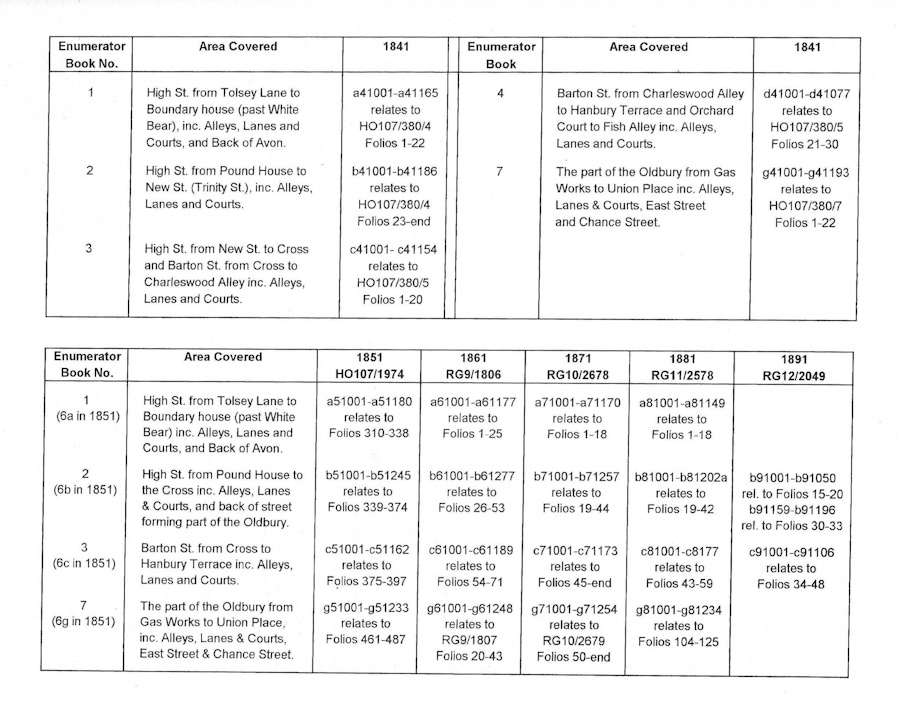
The information, including the transcribed Census returns for 1841 to 1891 for the Oldbury and surrounding area, can be viewed in the Tewkesbury database. For reference purposes a lower case letter, the census year and the schedule number was used, the lower case letter denoting a specific enumerator book. A guide relating this reference to the Public Record Office reference is given opposite.
The 1841 guide is listed separately because in that year there were three enumerator bookscovering the High Street but from 1851 onwards only two.
Transcription of the Census returns for the remaining parts of Tewkesbury is continuing using the P.R.O. referencing system. This information has been transferred to the Local History Database located on the computer at Tewkesbury Library. The database currently contains all the 1881 and 1891 returns for the whole of Tewkesbury and also 1841 to 1871 for Oldbury and surrounding areas. A researcher may view the information or obtain a location reference to view the original source, which is recorded on microfiche at the Town Library.
It is hoped that researchers will find this guide useful and, for the benefit of local historians in the year 2102, complete the 2001 Census schedule with the greatest of care!
Sources:
- Public Record Office Leaflet Guides
- Susan Lumas, Making Use of the Census, P.R.O. Publications (1997), ISBN 1 873162 43X
- Family Tree Magazines: April & June 1998; Jan. Feb. & March 1999
- Bob Woodard, ‘Nelson Street and Nail Alley’, T.H.S. Bulletin, No.2 (1993), p.53
The Editors would like to pay tribute to the hours of work donated by Mrs. Snarey to this most valuable of tasks. It is because she is now so conversant with the ways of the Census Enumerators that we asked her to write this article as a guide for all those who wish to make use of the census in Tewkesbury.
Comments