The Bloxham Family
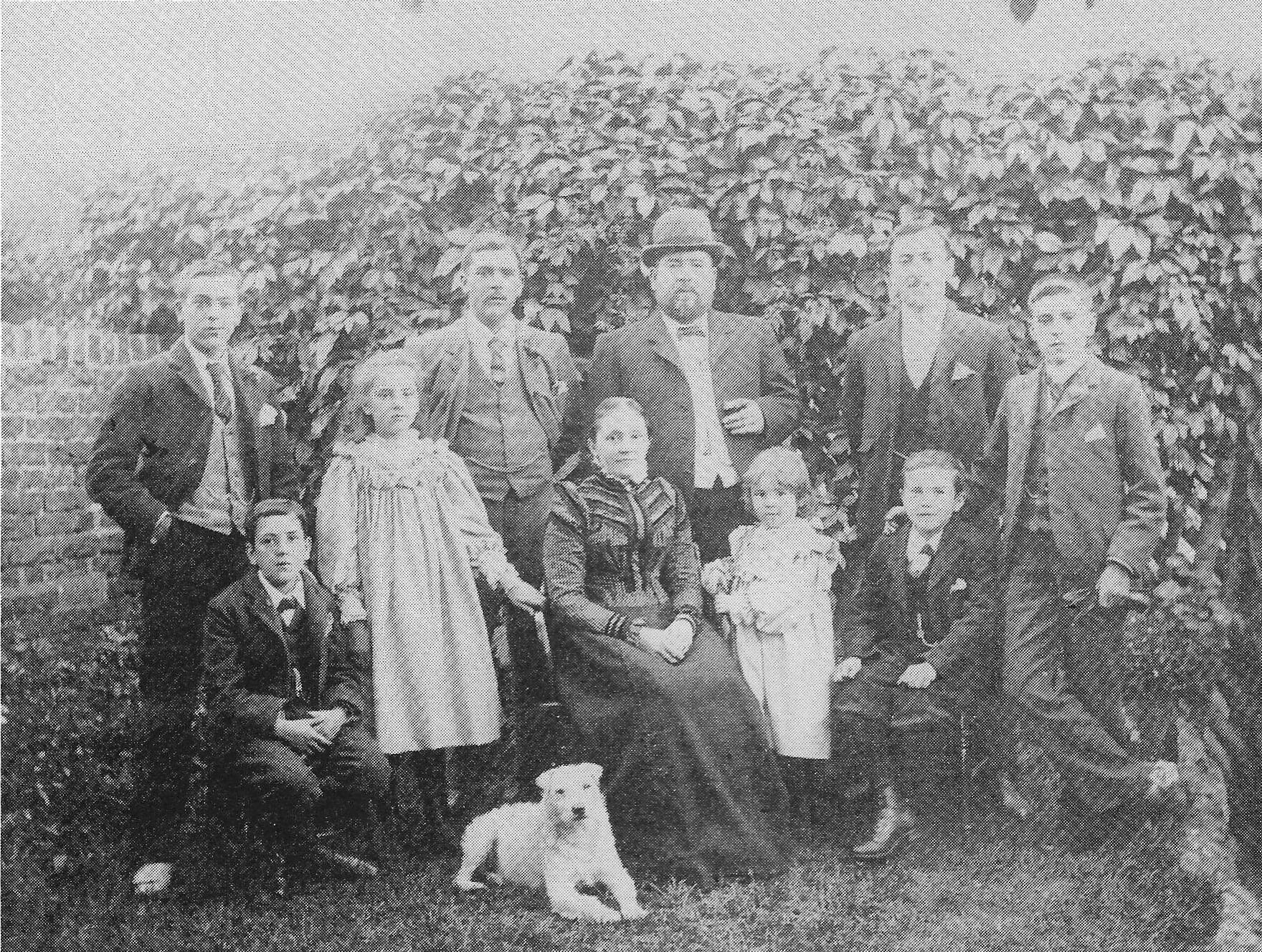
The Bloxham Family in 1900
They were blessed with a large family, eleven children in all, but unfortunately three died in infancy. The eldest son was called Bertie, short for Herbert, I believe. He was born in 1878 and, as a young man of 23, went to South Africa and fought in the Boer War. He came back to England safely and for many years he was landlord of the Star Inn at Painswick.
The second son was Roland, known to his family as Rolie. He went into farming at an early age and eventually had his own farm at Rudgeway near Tredington. I can remember happy times there when I was small, helping to feed the chickens and collecting Tewkesbury. The cattle and pigs etc. were bought from George Hone’s market in the town, and drovers were employed to bring them to the shop, and then down a long passage at the side of their premises to the slaughterhouse adjoining Swilgate Road. On those days, my mother told me, she used to run and hide at the top of the house.
They were blessed with a large family, eleven children in all, but unfortunately three died in infancy. The eldest son was called Bertie, short for Herbert, I believe. He was born in 1878 and, as a young man of 23, went to South Africa and fought in the Boer War. He came back to England safely and for many years he was landlord of the Star Inn at Painswick.The second son was Roland, known to his family as Rolie. He went into farming at an early age and eventually had his own farm at Rudgeway near Tredington. I can remember happy times there when I was small, helping to feed the chickens and collecting the eggs, although I once was chased by an angry cockerel and had to be rescued by my uncle.
After Rolie came Heneage, who on the outbreak of the First World War volunteered for the Army and enlisted in the 8th Gloucestershire Regiment. By Easter 1916 he had transferred to the Rifle Brigade and was promoted to Sergeant. Unfortunately he lost his life in 1918 and no trace of him was ever found. His only memorial is his name inscribed on the Menin Gate in Belgium.
The fourth son was Harry, who emigrated to Australia on 7th April 1910. He went with two friends, namely Jack Shill and Allan Tysoe, and my mother also records in her notes that they sailed from Liverpool on the S.S. Africa and went round the Cape of Good Hope, arriving in Sydney in May. Harry came back to England in March 1915 and immediately joined the Army, enlisting in the Army Service Corps, and also served in the 13th Hussars. After the war Harry went back to Australia and lived the rest of his life as a fruit farmer in Queensland.
Next arrival in the family was a daughter christened Helen Beatrice, but known to everyone as Nellie. Her war years were spent as a nurse at Mitton Manor in what was then the Red Cross Hospital. After her marriage she lived in Gloucester, where her husband worked for many years as a railway clerk. In middle age he was ordained into the church, serving first at St. Catherine’s in Gloucester, and then came to the living at Ashchurch as Rector, where he unfortunately died. Nellie lived to a grand old age at a nursing home in Gloucester.
The last two sons to be born into the Bloxham family were Allan and Raymond. Allan grew up to be a butcher like his father and after serving in the Army he came home and took over the business from his father. He eventually moved to Worcester where he ran a butchery business. Raymond, or Ray as all his family and friends called him, seemed to be the best known of all the sons, getting his name in the local paper quite often.
As a young man Raymond was a very keen footballer and became Captain of the ‘Tewkesbury Early Closers Football Club,’ also known as the ‘Tewkesbury Thursdays Club.’ In July 1912 he emigrated to Australia with another Tewkesbury man – a Mr. Frank Dee, who I believe in later years ran the Berkeley Arms with his brother. According to the local paper they were seen off from Cheltenham station by many friends, numbering at least ‘two hundred,’ who sang them a farewell song and wished them God’s Speed.
In 1914 Ray volunteered for the Army and joined the Queensland Light Horse with whom he served on the Western Front and was later wounded while in Palestine. A newspaper cutting I have states that Ray was attached to the Australian Camel Corps, doing long distance desert patrols linking up with Lawrence and his army. He was later awarded the Military Medal for bravery in the battles of Amman and Es-Sali in Transjordania.
After the war he came back to England and started his own butchery business in the Staunton and Corse Lawn area, and was well known driving around with his smart little grey pony and box-cart delivering the meat.
The last of the Bloxhams was my mother, Daisy, born in 1895, who was the diarist of her family. The earliest of her writings goes back to 1907, and then during the First World War she cut items from local newspapers and stuck them in a book, very precisely dating each one. She is the one I have to thank for all my information on the Bloxham family.
“There is an establishment in Tewkesbury (opposite the Hop Pole Hotel) that I have known for many years, and if you require a tender and juicy joint, you can get it here. The name of ‘BLOXHAM’ is sufficient, and every joint that leaves this business is guaranteed ‘quite English you know.’ If you should happen to dine at any of the leading hotels, or in fact with any of the nobility, gentry, or clergy in the district, the ‘piéce de resistance’ could be traced to ‘Bloxhams’ ‘All pure English-fed meat, and nothing foreign is the motto here.’
During the pork season there is a great demand for their sausages, and I know two or three families in London and the outskirts who regularly forward their orders to ‘Bloxhams.’”
This is part of an article written by someone called ‘Kate’ (I presume for the Tewkesbury Register) around 1905, only I have no proof of the date. K.H.
Comments