
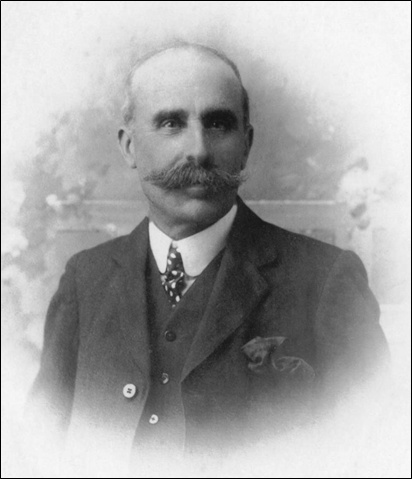
Humphrey King (1853-1931)
Tewkesbury’s Redoubtable Victorian Ironmonger
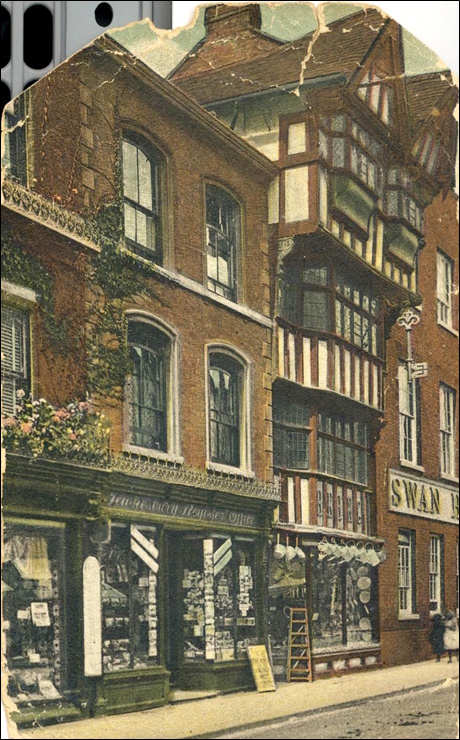
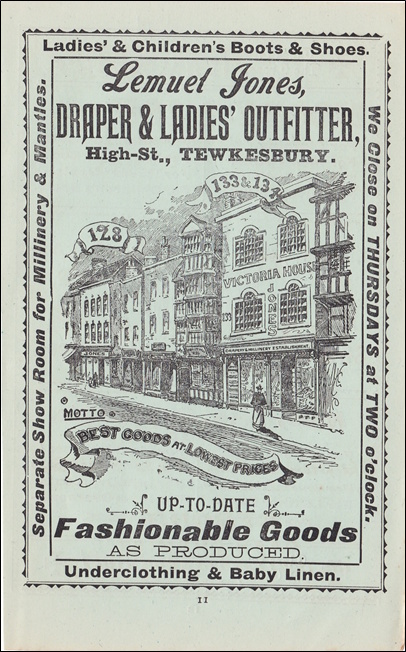
I well remember as a child being brought to Tewkesbury by my father (Humphrey Richard King 1917-2001) and having the emblematic House of the Golden Key (or House of the Nodding Gables as it was also called) in the High Street pointed out to me. This was where my great-grandfather, Humphrey King, had engaged in his business, although the sign ‘H. King Ironmonger’ had disappeared some years before. My father had very clear memories of his grandfather as a kindly old gentleman. Indeed, I have in my possession an affectionate letter written in March 1931 to his grandson, then a chorister at Lichfield Cathedral, just five months before he died.
The letter indicated that the ironmongery business was sluggish at the time and that my great-grandfather was concentrating upon breeding and selling pullets along with the equipment necessary for keeping poultry in order to maintain the business.
Humphrey’s Early Life and Career
to Expand
Humphrey King was not a native of Tewkesbury but was born at Ablington, near Bibury, on 15 March 1853 to a long-established Cotswold family. His father, Edmund King, was described in 1853 as a farmer and in the 1861 Census as a farm bailiff. I know virtually nothing about my great-grandfather’s early life except that, in the 1861 Census for North Cerney, he was listed as a boarder at some kind of educational establishment there. By 1863, however, he was a pupil at the historic Ewelme School[1], one of the oldest functioning maintained schools in the country.
We know that in the early 1870s, he was already apprenticed to an ironmonger in Swindon and that, as early as 1876, he came to Tewkesbury as manager of the firm of Messrs Land and Hemus, whose shop at 148 High Street is currently occupied by a mobile phone business Get Connected. It was he who took over the Nodding Gables shop at 9 High Street. Mr. Hemus eventually became the sole proprietor of the firm and, when he retired, my ancestor took over the flourishing business in partnership with a certain Mr. Sam Handley[2] of Halifax Works. At that time 9 High Street – known as the Old House was one of Tewkesbury’s most picturesque ancient houses. The partnership was dissolved by mutual consent in 1898, at which point the business came under the sole ownership of ‘H. King’
Agricultural Diversification
to Expand
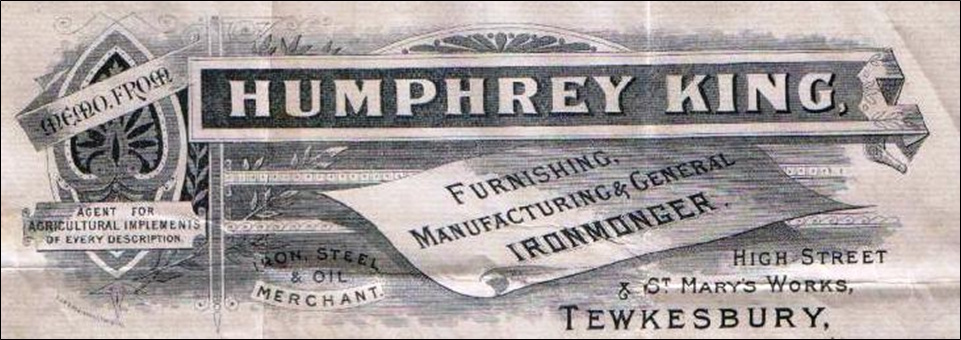
We might well wonder nowadays how a young man who was literate and reasonably well educated by the standards of the time should have been encouraged to train as an ironmonger[3]. For information, the term used to describe my great-grandfather’s occupation in official documents was ‘agricultural ironmonger’.[4]
But even this more specialist occupational description hardly seems to do him justice, given that he subsequently became both patentee and manufacturer of a range of popular and commercially successful agricultural equipment. One such piece of equipment was King’s Improved Hay Elevator; my father and I were fortunate enough to encounter one of these still in operation in the 1960s in a hayfield just south of Glasgow! According to an article from the Tewkesbury Register of 11 November 1933, H. King was successful even further from home, securing a contract to supply a number of these elevating machines to the Government Cattle Farm, Hissar, Punjab, India. These were manufactured in St. Mary’s Yard, taken over by H. King in 1911 on the closure of William Knight’s Chemical Works.
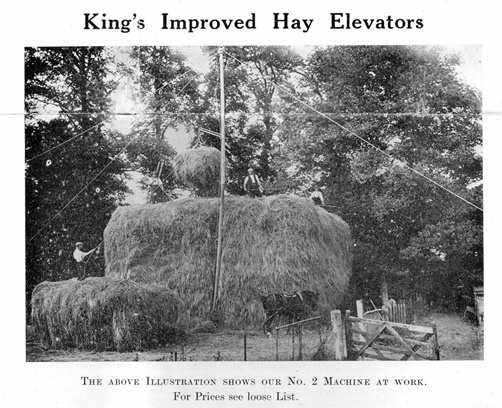
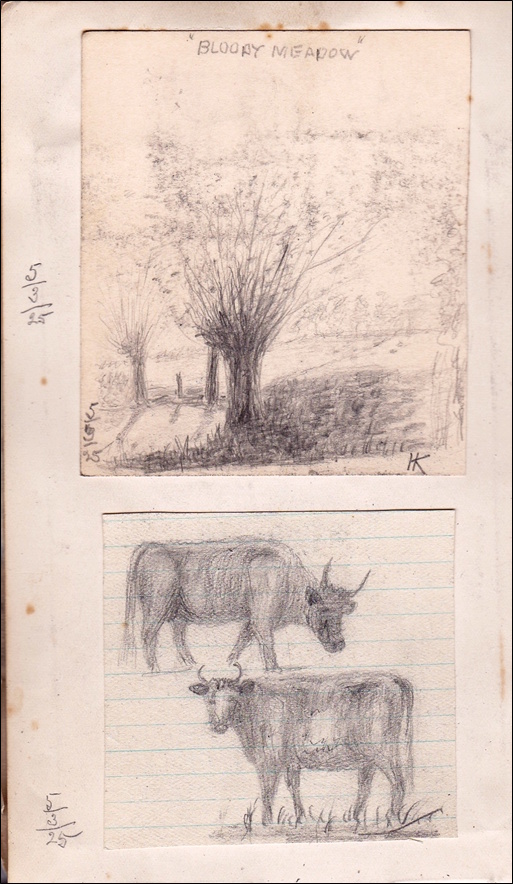
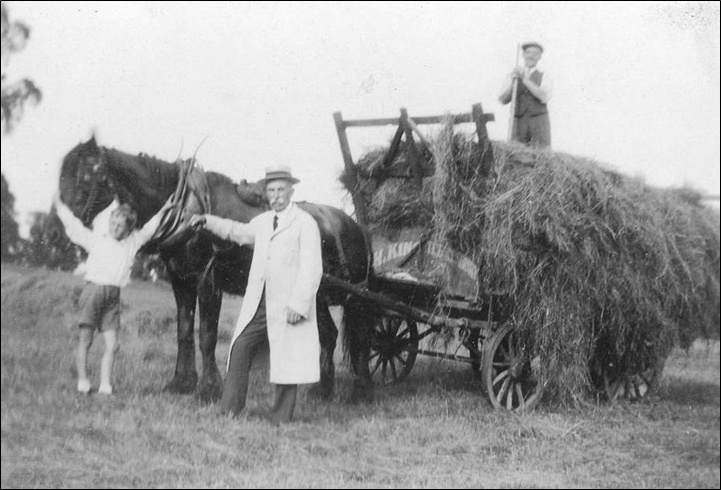
H. King’s insight into the needs of the agricultural community must clearly have owed something to his own practical experience of farming. He rented Bloody Meadow and part of Gastons from James S. Sargeaunt of Tewkesbury Park (the rent in 1910 was £73 per annum) as well as Windmill Hill Field which is now the site of the Council Offices. I possess several photos showing him haymaking at Windmill Hill as well as drawings made by him of willow trees and cattle on Bloody Meadow. It also turns out he was a talented amateur artist.
Changes of Residence
My great-grandfather moved around a good deal during his life in Tewkesbury. Although his business prospered, he never owned either the houses in which he lived or his business premises or the fields which he farmed. Curiously he sublet part of one of the fields he rented to Tewkesbury Grammar School for use as a playing field (for £12 per annum in 1921). The 1881 Census records him living with his family at 2 Barton Terrace, on Barton Street. The newspaper report announcing the death of his first wife places him at this time at 146 High Street. The 1891 Census lists him as occupying two adjoining houses, 148/9 High Street.
Humphrey’s Passing
to Expand
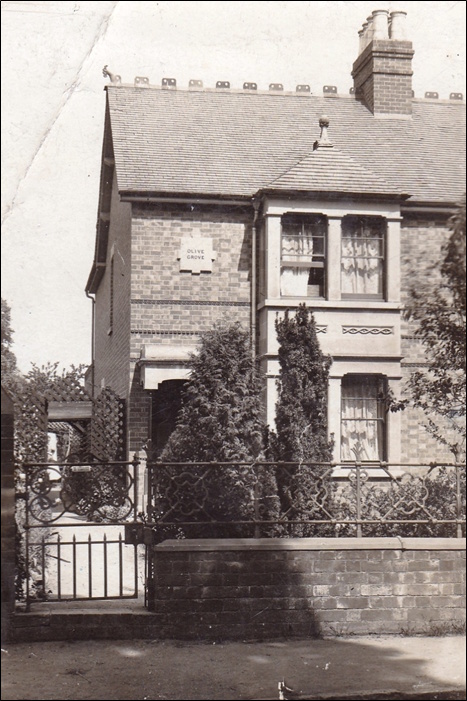
By 1901 he was resident at Osborne House, 9 East Street and it was not until the 1901 Census that he is recorded as living at Olive Grove, Gloucester Road, the home that he would occupy until his death in 1931 and where his second wife Kate predeceased him in 1924.
H. King left an estate of £4,031 despite the increasingly difficult trading conditions in the 1930s.[5] My grandfather, Ewart Walter Edmund King, took over the business but it was already in decline and ceased to trade in about 1935. According to family legend the business was owed a good deal of money by local farmers who were also experiencing difficulties at this time. There was an auction at which all the remaining stock, down to the last nail and roll of wire, was sold along with the entire contents of the workshop.[6]
According to his newspaper obituary my great-grandfather played a very active part in the life of Tewkesbury. From 1897 until 1906 he was a valued member of the Town Council and, after leaving the council, was always ready to promote any project that would make for a better Tewkesbury. He was the principal mover in the foundation of the Tewkesbury Town Band and in December 1906 was presented with an enlarged photograph of the band in recognition of his services on behalf of the band as its chairman. At one time, I believe, he was a squadron-sergeant in the old Gloucestershire Yeomanry. He chose to be buried in his adopted town alongside his second wife, Kate.
Sporting Pursuits
from the King Archive
Humphrey was also an enthusiastic field sportsman, both shooting and following the local hunt. In his younger years he was a ‘puppy walker’ with the Croome Foxhounds and the Boddington Harriers. In connection with this interest in field sports, he was also an accomplished taxidermist and my father used to tell of being frightened to enter his Olive Grove home in Gloucester Road, on account of the fierce stuffed animals on all sides. An advertisement of 1910 indicates that he combined the role of gunsmith with that of ironmonger, making and marketing his own cartridges
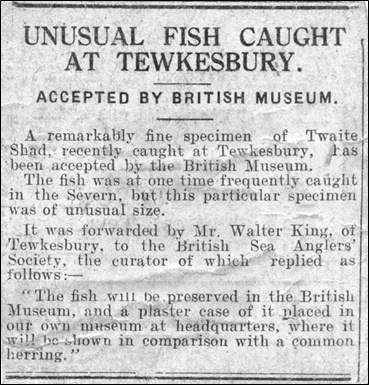
He was also an angler and I have found an undated article from a local newspaper reporting “An Unusual fish caught at Tewkesbury” which tells how a “Twaite Shad”[7] had been caught in the Severn, either by my great-grandfather or possibly by his son Walter. This was a specimen that had in the past been common but the fact that it was then rarely encountered and that this was a particularly large example made it noteworthy. It was given to the British Sea Anglers’ Society who presented it to the British Museum where it is still preserved.
to Expand
H. King’s love of the natural world, as well as his considerable artistic talent, was evident in one of his sketchbooks, dating from the period 1925-30. These effective yet simple sketches feature a wide range of wild and domestic animals and birds, as well as trees, flowers and picturesque scenes from local villages. On his visits to his daughter in Birmingham he would spend time in Birmingham City Art Gallery sketching details from paintings portraying landscapes and animal scenes.
Given Tewkesbury’s location at the junction of the Severn and Avon, it is perhaps not surprising that water, both as a place for recreation and a hazard, should have played some part in my ancestor’s life. The water that periodically flooded his High Street premises certainly served as a reminder of this proximity!
In the Register for 13 June 1903 the name of ‘H. King’ appears as one of the Directors of Tewkesbury Athletics, Sports and Horticultural Co Ltd, which was responsible for organising the Tewkesbury Regatta – an annual event held since 1861 and drawing crews from all over the country. Some years before this, on 2 February 1890, it reported that “Mr King, Ironmonger, and Alfred Roberts - Horse and Trap Fell Through Rail into Flood on Mythe Road - All Survived”. This was not, however, my ancestor’s only aquatic mishap. On 29 December 1929 the newspaper reported the following dramatic incident: “A tug towing a barge containing 100 tons of grain broke away at Diglis Lock when the tow-rope snapped. Captain and Mate, Messrs W. Hawker and H. King (Tewkesbury men) were on board the barge but were rescued just before the weir. Mr W. Hawker, aged 71, collapsed but was revived”.
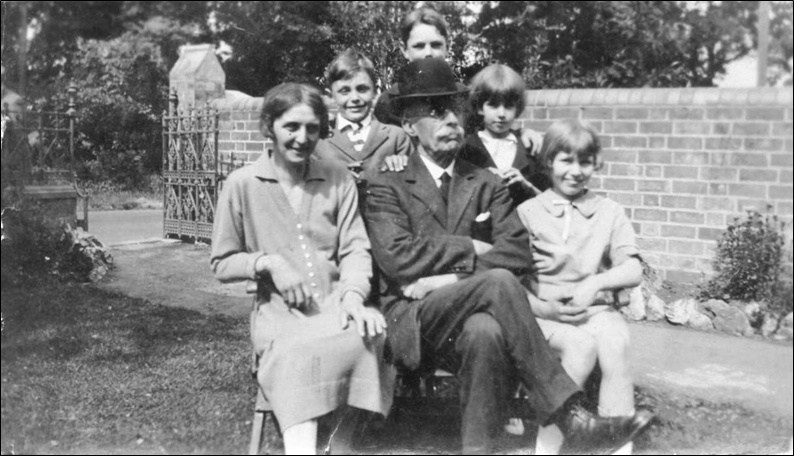
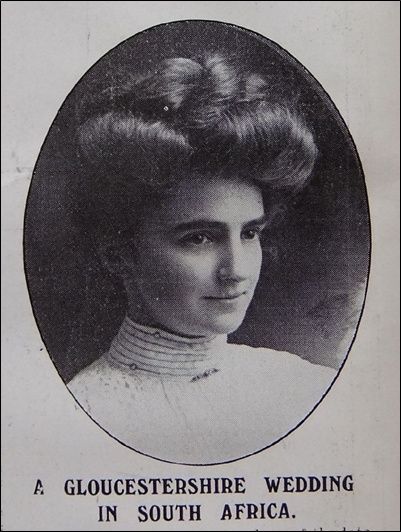
As well as making a considerable all-round contribution to life in Tewkesbury my great-grandfather enjoyed a happy family life. His first wife, whom he married in 1876, was Caroline Agnes (née Herbert, 1850-1888) of Nympsfield, by whom he had two children. His son, my grandfather, Ewart Walter Edmund King (1881-1963), who married Eleanor Beatrice Strawbridge Rusling (1891-1984) in Bushley in 1914, and had three children, Anne Strawbridge, Humphrey Richard and Derek Walter. His daughter, Beatrice Annie (1883-1941) who married W.H. Jones in Cape Town, South Africa in 1911, resided in Birmingham and had a daughter Gwynfa and a son Humphrey. His second wife was Kate (née Chandler, 1862-1924), youngest daughter of Neighbour Chandler of Teddington Hands Tarn, Overbury. He was a very affectionate and popular grandfather and illustration 10. is one of several photographs I have of him with his grandchildren while hay-making as well as in the garden of Olive Grove.
Conclusion
The tribute paid to Humphrey in the Tewkesbury Register on his death in August 1931 reflects a life well lived. “His death will occasion sincere regret not only in Tewkesbury, but all over the country, for he possessed a very wide circle of friends, and all his life had earned the respect and affection of all with whom he came in contact both in his business and social life.”
In researching my great-grandfather’s life, I have fulfilled my ambition to confirm that he was no mere shopkeeper but extended his interests into manufacturing benefiting from knowledge of the lives of farmers and his own family experience. He displayed considerable ambition and enterprise, not just in developing his business but in the very full part which he played in so many areas of Tewkesbury life.

JOHN KING was born and brought up in Reading, Berkshire and went on to read Modern Languages at St. Catherine’s College, Oxford. He taught at Eton College for 36 years until his retirement in 2011. He was a House Master at Eton for 13 years. In addition to his interest in everything Hispanic, especially ceramics, he is now researching both his King ancestry as well as that of his Rusling great-grandfather from Bushley. He currently lives in Englefield Green, Surrey with his wife and makes frequent sorties from there to help with grandchildren.
References
- https://ewelmeprimaryschool.com/history/
- 1860-1942, Handley’s main shop was 49 High Street [in 2019 Melanie’s Café] with a warehouse in St. Mary’s Lane and occupying a home at 23 Church Street.
- It is interesting to learn that in 1759, the great diarist Parson James Woodforde’s problematic younger brother was apprenticed to a Bristol merchant ironmonger. Clearly it was viewed as a respectable occupation for the son of a traditional ‘county’ family over a hundred years before.
- Dealing in equipment including Grass Mowers, Swath Turners, Hay Tedders, Horse Rakes, Hay Loaders, Hay Elevators, Spring Cleaning Requisites. Portable Ranges, Boilers, Ironing Stoves, Washing Machines, Wringing Machines. Cream Separators, Milk Churns and Refrigerators and Butter Churns.
- The £4031.19s.6d value of his estate in 1931 is perhaps around £260,400 in modern values, but for the vagaries of such calculations see https://www.measuringworth.com/calculators/ukcompare/
- His trustees sold his “workshop and yards St Mary's lane extending to Mill Avon;3,300 sq feet” [Tewkesbury Register, 3 Aug 1935 p5/1]
- https://canalrivertrust.org.uk/enjoy-the-waterways/fishing/fish-species/rare-and-protected-fish/twaite-shad
Comments