
Alfred Peachey (1856-1925)
The Poet
The biography of Alfred William Peachey perhaps reveals little of his ‘inner life’ as a poet.
He was born in Tewkesbury in 1856, in the same year as the marriage of his parents Samuel Peachey, a labourer, and Hannah Cresswell, stocking maker. When Alfred was aged four, his father died; he then lived with his mother and a fifteen-year-old step-brother, Samuel Cresswell. In the 1871 census, Alfred and his mother seemed to disappear – the reason being that Hannah had married widower Thomas Holland in the summer of 1861 and was living in the same home in Spring Gardens. Alfred had taken his step-father’s name whilst he was working as a painter. As we know, Thomas obtained a noteworthy status through losing both hands in a stocking machine accident in 1865.[3]
Alfred did not maintain his new name when he married Sarah Buckle in Gloucester in 1877. She was, in fact, the daughter of Samuel Buckle, framework knitter, and lived next door to the Peachey/Holland family at 11 Spring Gardens. After marriage, they were living in Trinity Place in 1881 when Alfred was described as an “Outfitters Assistant”; they had a young son Gilbert Alfred (1879-1933) and a live-in governess. Alfred is reported as working as a shop-keeper in Station Street in 1885.
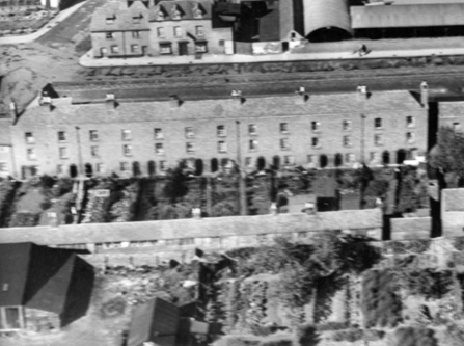
![<sub>Thomas Holland and his wife,<br>the former Hannah Peachey,<br>dated between 1861 and 1883 [Tewkesbury Museum] </sub>](images/THS02249.jpg)
the former Hannah Peachey,
dated between 1861 and 1883 [Tewkesbury Museum]
Alfred W. Peachey had his volume of poetry published in 1885.[4] At the same time, he was also renting part of 72 Barton Street where a certain A. W. Peachey advertised “rheumatic cures”.
Although he continued with the occupation of outfitter, by 1891-1901 the family had moved from Tewkesbury to live in Cheltenham, firstly in Cotswold Cottage, Charlton Kings, and subsequently in Swindon Street, St. Paul’s.
Even if his personal history does not reveal many insights into the mind of our poet, there are some newspaper items relating to him that allow us a glimpse into his character and life. He was, for example, involved in two court cases. In 1887 the Cheltenham Chronicle reported that the poet, still an outfitter, but residing at 7 Stoneville Street, was a witness in a court case against a “disorderly drunkard”. In 1899 he was involved in a civil dispute after having been elected “Secretary pro tem of the Bridge Inn Club on the Tewkesbury Road”.[5]His emerging poetical prowess was recognised in 1893 when the Gloucestershire Echo stated:
A local writer of verse, who sent some congratulatory lines to the Duke and Duchess of York, has received the following letter: Major General Sir Francis de Winton is desired by the Duke and Duchess of York to send the warm thanks of their Royal Highnesses to Alfred William Peachey for his kind lines of congratulation and good wishes.[6]
In 1900 the Gloucester Citizen published a long letter to the editor concerning Shakespeare’s links with Tewkesbury. In this Alfred states:
In Tewkesbury Abbey churchyard, underneath the chestnut tree, and opposite that ancient hostelry, the Bell Inn and Bowling Green, which is immortalised by Miss Muloch in John Halifax, Gentleman, stands an upright headstone bearing the following inscription: “In memory of John Hart, who died January 22nd, 1800 (the sixth descendant from the Poet Shakespeare), aged 45 years”. He also mentions Shakespeare’s use of the expression “as thick as Tewkesbury musard”.[7]
His next letter to the editor in 1900 was more political in intent and commented on the necessity for a balance between the necessity of commerce to open at Christmas for “three days for business when money would be forthcoming” but also the need for paid holidays for shop assistants and railway workers giving “four days (including Sunday) for pleasure”. His son was, by this time, a railway employee; Alfred also reveals that he was living at “94 Southgate Street. Gloucester”. [8]
Peachey’s PoetryHowever, it is to the poems themselves to which we must turn in order to learn more about the poet and his interests.
The Preface
In the preface to the poems, the poet expresses his intention “to paint with words” as true a picture as the nature of the subjects would permit, in accordance with his own mind. Most of the poems are written in iambic measure,[9] which was applicable to every subject “from grave to gay, from lively to severe”.
With regard to Margaret of Anjou, one of the two long poems in the volume, the other being The Red Rose Boy, he adds that this was “written for the most part on the very spot where Margaret’s camp lay, and has been composed as carefully as imagination and historical facts possessed by the Author would allow”.10
The preface concludes with the following statement: “the Author hopes this small work will meet with the sympathy of the public and that its teachings will be found within the limits of religion, temperance, and morality”.
It would be impossible to cover in detail the 27 poems contained in the “small work” to which the poet refers; it is hoped that the following brief outline will whet the reader’s appetite to find out more about this Tewkesbury poet.
The Poems
His poems were evidently written prior to 1885 (when he was living and working in Tewkesbury). It should, therefore, be remembered that he adopts a mode of language and themes that can sometimes sound a little dated and contrived to modern ears. Also, although primarily interested in historical and religious themes, the poet often expresses himself most succinctly when dealing with the natural world.[11] Even then, however, the religious overtones are never far away. In Birds, for example, he writes that:
I love the birds that gaily sing
Their merry tuneful lay,[12]
And soar aloft on tiny wing,
In silver noon-tide ray.
They sing a theme of endless praise,
And worship Him on high,
And bid us come, our hearts to raise
To God above the sky.[13]
That we may taste of our free will
The produce of the land.[14]
He is possibly at his best when describing nature in an immediate way that is freed of religious metaphor, as in the short poem Nature’s Charms:
The flowers that bloom, the birds that sing,
The water’s gentle stream,
The wooded vale where zephyr’s bring
Sweet scents for fairy queen;
The mossy bank where wood nymphs skip,
The massive shady tree,
The silent pool where willows dip
Their heads, gives joy to me.[15]
The house where the Prince was murdered stands in the middle of the town, and is occupied by J. Willis. He was murdered by the hands of the Duke of Clarence, Duke of Glo’ster, the Marquis of Dorset, and Lord Hastings.[16]
The poem begins on an ominous note:The dismal croak of the wandering frog
Is hushed, as it nestles within the bog.
Yet in the gloom, behold a camp
Of British soldiers, sworn to stamp,
Or cut the Yorkists to the ground,
And have their cause with victory crown’d.
The arrows fly on every side,
And knights their chargers wildly ride.
While, stretched full length upon the sod,
And steeped, within their own life’s blood,
The wounded, dying, and the dead
Around on every side are spread.
Went forth to bring
The Prince’s person to the king.
My father’s kingdom to regain
and after him the same retain,
The poem ends with a message of hope that:
Oh would to God that men would find
Some acts and deeds of nobler kind
Than evil strife or bloody war
Whereby to spread their names afar.[17]
Margaret of Anjou
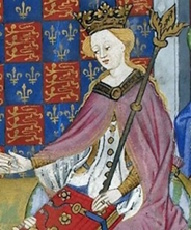
Margaret of Anjou, the second major poem in the volume, deals with a similar theme, namely the Battle of Tewkesbury. This time it begins after the battle when:
The battle’s[18] o’er, the victory’s won,
And Edward claims the British throne;
He dons the crown, and sits elate,
And glories in fair Margaret’s fate.[19]
The poem moves on to describe Margaret’s attempt at escape, her rescue by Thomas Payne[20] and her refuge for several days in a poor house of religion not far from Tewkesbury.[21] Eventually Margaret is captured, but she questions:
But why should she, a comely Queen,
Be thus led forth a prisoner mean
Thro’ woods and lanes, and o’er green fields,[22]
’Mid noble soldiers, swords and shields?
With none to bless and call her own.
No crown, no husband, and no son,
Nor e’en a father; all are gone.[23]
The Poet and his Family
Albert’s son, Gilbert Peachey, became a Great Western Railway cleaner in 1897 and worked in both Wolverhampton and Oxford, where in 1902 he married Minnie Simmons. Gilbert moved to Birkenhead in 1907 where he was living in 1911 with his wife and three children. In 1919 he was fined by the Great Western Railway for letting his father (Alfred) use his wife’s concessionary rail ticket! His railway records reveal that he was suspended for excessive drinking of alcohol in 1926 and, when reinstated, it was only as a shunter driver. Significantly he had moved to Chester in 1912 and died there aged 54 in 1933. We can assume that his father was at least visiting him – or was he living with him – when he also died in Chester in 1925 aged 69.
The marital relationship of Albert Peachey is more difficult to determine, as at the time of the 1911 census he was living alone at 7 Malvern Street, Tewkesbury Road, Cheltenham, and working as a shop assistant in an outfitters. However, his wife Sarah was staying with relatives at 7 Providence Square, Mountfields in Shrewsbury. The relatives were William and Eliza Birch, Eliza being Sarah's sister. William worked as a corporation labourer. Whether Sarah was merely visiting her sister, or if her separation from her husband was more permanent, is currently unknown as is the date and place of her death.[24]Conclusion
It would be impossible in a short article to cover all of the poems in this volume. However, it is hoped that a flavour of the work will encourage others to carry out further research.
It would be interesting to know, for example, to whom the poems The Penitent Drunkard, To a Dead Child and The Adopted Brother refer. Or to glimpse at the images mentioned in the poem For a Photographic Album, which might answer several outstanding questions!
Beloved book, whose pages bring
Departed friends to view,
To whom fond memory e’er will cling,
And praise where praise is due.
References
- A member of the National Union of Journalists, Mike Everley has also had poetry and short stories published in numerous literary magazines such as: The Anglo Welsh Review, Outposts, Cardiff Poet and Cambrensis. A short collection of his work entitled The Ghost Swift Moth is available in Kindle format from Amazon.
- For example: the Robert W. Woodruff Library, Emory University, Atlanta; the Hamilton Library, Franklin College; the Hathi Trust Digital Library; the Texas A&M University-San Antonio; the Shields Library, University of California and the University of the West Library.
- There is some evidence that Thomas Holland received an award in 1883 due to the loss of his hands, but this is still to be confirmed. For more information read M. Everley, Thomas Holland (1826-1907) in THS Bulletin 17 (2008). The Tewkesbury Register, 26 August 1865, records the accident.
B. Linnell profile of 72 Barton Street to be consulted on the online Woodard Database.
- Cheltenham Chronicle, 18June 1887 and 8 July 1899.
- Gloucestershire Echo 12 July 1893, p.3. The congratulations were for the marriage of the future King George V to Mary of Teck.
- Gloucester Citizen, 13February 1900 p.3.
- Gloucester Citizen, 27 November 1900 p.3.
- Iambic is defined as poetic verse that is made up of iambs, which are metrical feet with two syllables, the first syllable is unaccented (-) and the second is accented (/). English poetry often makes use of lines with five iambs known as iambic pentameter. Thomas Gray’s Elegy Written in a Country Churchyard is a famous example: “The curfew tolls the knell of parting day”.
- Both Margaret of Anjou and The Red Rose Boy are supplied with copious footnotes.
- As a keen cyclist, the poet obviously enjoyed the sights of the natural world on his various trips.
- A ‘lai’, from Middle English, is narrative poem, such as a ballad, sung by medieval minstrels.
- The First World War was to test severely this notion, but develop into Christian Fundamentalism in America.
- Does this suggest that the poet believes that there will be a future “heaven on earth” rather than with God “above the sky”?
- A ‘zephyr’ can mean either a gentle breeze or, more specifically, the west wind (Middle English Zephirus, Zephyrus, from Latin Zephyrus, from Greek Zephuros). A ‘wood nymph’ is a nymph of the forest; a dryad. In classical mythology, a nymph is a minor nature goddess usually depicted as a beautiful maiden; the ancient Greeks believed that nymphs inhabited forests and bodies of water.
- This footnote quotes from Malvern Chase by the Rev. W. S. Symonds. A brass plaque in Tewkesbury Abbey marks the resting place of the Lancastrian Prince of Wales, Edward, son of Henry VI and Margaret of Anjou. He is buried near the altar but it is not known exactly where. It is also not known if the prince was killed in battle or executed shortly afterwards, as suggested by the poet. One account mentions him unsuccessfully seeking mercy from his treacherous brother-in-law, George, Duke of Clarence, brother of Edward IV. However, another account has the captured prince being brought before Edward IV and defiantly claiming his birthright. Edward then allegedly struck him and his men then fell upon the prince and killed him.
- One wonders how the poet felt when about 30 years after this poem was published the even bloodier and needless slaughter of the First World War began.
- The poet adds in a footnote that the ‘bloody field’ was, according to Bennett’s History of Tewkesbury: “The Gaston Field near Tewkesbury Park, now well-known as the ‘Bloody Meadow’, lying to the westward of the turnpike road, beyond the Windmill Hill, and within a few hundred yards of Tewkesbury Union”.
- Margaret of Anjou was the wife of King Henry VI. As such, she was Queen of England from 1445 to 1461 and from 1470 to 1471. Margaret was taken prisoner by the victorious Yorkists and was ransomed by King Louis XI of France. She went to live in France as a poor relation of the king, and died at the age of 52.
- It is thought that Queen Margaret escaped from the battle scene along with her daughter-in-law Anne Neville and was taken to Payne’s Place in Bushley, across the Severn River from Tewkesbury, where she stayed a night before going to a nearby priory. Payne’s Place was claimed by historian E. R. Dowdeswell as having been built in 1450 by Martin Payne, a merchant from Tewkesbury. His descendants, Thomas Payne and his wife Ursula, were the ones who sheltered Queen Margaret. Thomas Payne was closely associated with Anne Neville’s father, the powerful Earl of Warwick. Richard Neville also owned land in Bushley and was called ‘the Kingmaker’ for his role in assisting at different times both the Lancastrian Henry VI and Yorkist Edward IV. Thomas and Ursula Payne are represented by brass figures to be found in the Church of St. Peter in Bushley. Thomas Payne’s recognition perhaps came from his role in gaining permission in 1477 for burying the Bushley dead there at St. Peter’s Church rather than as previously by carrying the corpses across the river to Tewkesbury. He died in March 1500.
- The poet claims in a footnote that Margaret’s place of refuge was the Old Castle at the Mythe, at his time the property of Mrs. Ruddle. He also quotes Malvern Chase: “Margaret assisted by two monks is supposed to have crossed the Severn just above the Redbank … The room Queen Margaret occupied during three days of bitter anguish, is called the ‘Queen’s Room’ to this day”. Malvern Chase is a novel, written in 1880 by W.S. Symonds; it involves an historical reconstruction of the battle and is supposedly based on much documentary evidence. In this account, Thomas Payne was condemned to be hanged for his role in helping Queen Margaret, but he was pardoned through the plea of the novel’s protagonist, Sir Hildebrand, to Edward IV.
- The poet adds a footnote from Norman May: “At this time Malvern Chase existed, extending from the river Tame in the north to Cors Forest on the south, and from the Severn on the east, to the top of Malvern Hill on the west, covered …. 600 acres in Herefordshire, 100 in Gloucestershire, and formed a continuous line of thick woody, marshy wilderness, from near Tewkesbury to beyond Bewdley. A distance of between 30 and 40 miles”.
- According to the poet: “She died in the year 1482 and is buried in the tomb of her father, without any epitaph or inscription”.
- We are indebted to the ‘MJ-Buckle’ family tree on www.ancestry.com
Comments