‘Tying The Knot’ – 1940s Style
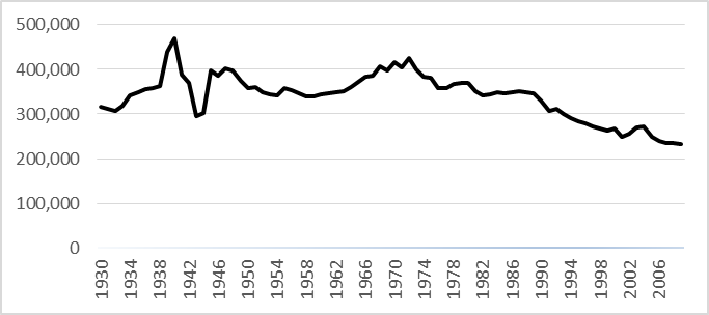
Given the record surge of marriages that took place in England in the late 1940s, it is striking how little internet information there is on this fascinating aspect of our country’s social history. The situation could not contrast more significantly than with America where correspondingly huge volumes of factual material exist online. (Ironically it is these that mostly turn up during English web searches.) This is the unwitting discovery that provides the motivation for the article that follows, which – based on a family case history – offers personalized insights on marriage customs some seventy years ago.
The Wedding Cake
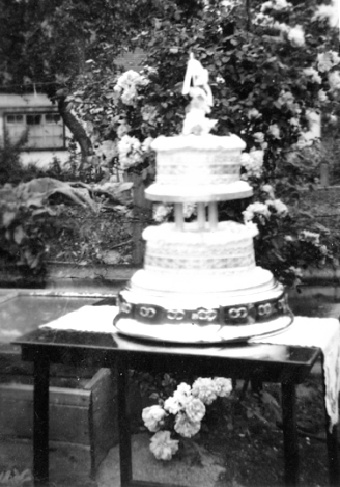
Engaged for nearly a year, the couple had been saving assiduously for their ‘big day’. At least Doreen had – Neville had never been much of a saver – and, by the time of the marriage, she had managed to put by nearly £10 – £5 of which went towards their wedding cake (from Leopold’s on the High Street) and £2 for the hire of the trestle stand that supported it.[2] This was quite a noteworthy outcome in the 1940s: just a few years previously, the cake – if there had been one at all – would most likely have been a ‘cardboard’ model. Placed over the real cake, this is what guests would have seen and what would have appeared in photos. It was actually, however, the much smaller cake beneath it that would have been for consumption.[3]
On and Off Engagement
Finishing his war service as an army cook in Germany, Neville had returned to Tewkesbury as something of a local hero. With a seemingly inexhaustible supply of friends, he would celebrate with them nightly, at the Wheatsheaf pub on the High Street – to Doreen’s considerable indignation.[4] On more than one occasion she became so fed up with the situation that she sent the engagement ring back to him via her younger brother, Tony, who was told to pass on the message that “you can keep it”! The first time this happened, Neville refused to accept the ring and managed to talk her round later – by pledging to behave more considerately. The second time a remorseful note that he sent back via Tony met with no response. Soon afterwards, however, he ran into her in the High Street where she was shopping with her next-door neighbour, Joyce. Escorting her up to the Sabrina Cinema, by the time they had reached Picture House Alley (close to where Bishop’s Walk is now) the engagement was back on again. When Joyce heard about the change-of-heart afterwards, she was said to have been dumbfounded!Cotteswold Road
Prior to her marriage, Doreen had been living with her parents and four siblings in a three-bedroomed house in Cotteswold Road. Conditions – very cramped – were far from conducive to peaceful family relations. Doreen and her strong-minded mother, Tillie, would frequently clash, especially over Neville whom Tillie considered to be totally unsuitable husband material for her daughter. Doreen’s father, Bert Senior, in contrast, was much less judgmental about the situation. “It’s her choice – let her choose who she wants”, he would counter.
In 1948, Tillie and Bert (Matilda and Albert Bayliss) had been married for twenty-six years and were parents of six.[5] Doreen was the second eldest of their children. Her brother Bert Junior was two years older than her and his role in the wedding was actually to prove quite crucial. Not long married himself to his sweetheart Nancy, it was Nancy’s bridal dress that Doreen was to be wed in.[6] No less importantly perhaps, Bert also assumed the role of ‘official’ wedding photog-rapher for the occasion. This type of make-do improvisation was very common in the 1940s and chimed well with the “something old, something new, something borrowed, something blue, a silver sixpence in your shoe” advice given to brides-to-be at the time.[7]
Tillie had been vehemently opposed to the wedding from the outset and on the day itself – right up to half-an-hour before the wedding – she and her sister, Emily, did their utmost to talk Doreen out of marrying Neville. Their arguments reduced essentially to (i) it was still not too late to back out, (ii) she didn’t have to get married, and (iii) if she did marry Neville, she would never have a penny to her name. Then, unexpectedly, Neville’s friend George Clifford dropped by to present Doreen with a cross and chain from her husband-to-be. Suddenly any lingering doubts about the marriage happening seemed to vanish. Unaware of how this presentation had swung the odds in his favour, Neville meanwhile was leaving the Oddfellows Arms, where he had adjourned for some much needed ‘Dutch courage’.[8]
Wedding Day
The wedding, at Tewkesbury Abbey, was followed by a reception in a lounge on the first floor of the Sabrina Cinema with photos taken opposite at the Tudor House Hotel.
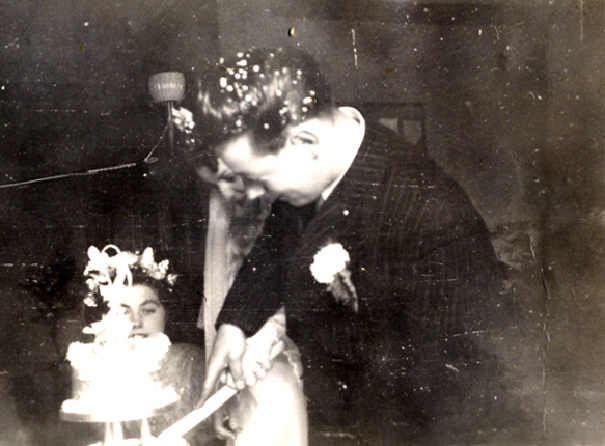
Confetti was mostly unavailable during the 1940s and would often be simulated using hole-punches on old exercise book covers – as is evidenced perhaps in the photo of cutting the cake.
Doreen was three weeks short of her twenty-first birthday, so strictly speaking would have needed her parent’s permission for the wedding to go ahead.[9] (The suspicion is that, left to her own devices, Tillie would have refused – but was possibly talked around by her husband, for fear of driving Doreen into Neville’s arms.)
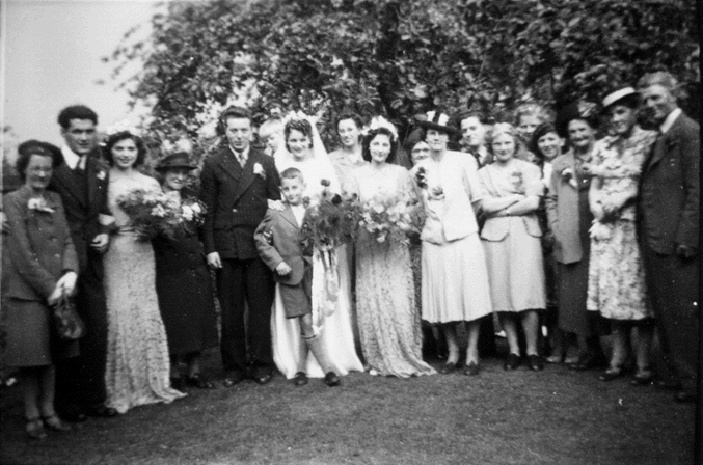
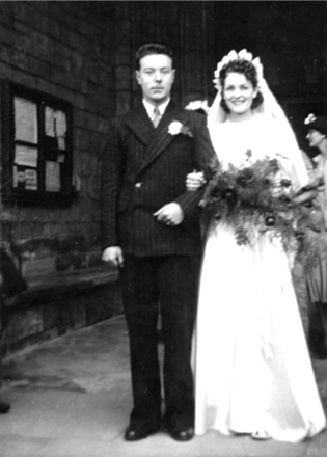
The wedding guests: To Neville’s left is his mother, Lizzie; to Doreen’s right is her sister Barbara, and right of her, their mother, Tillie. On the far right is Bert Senior who is standing next to Nancy, and next to her, Doreen’s grandmother, Edith Cash. In front of the newlyweds is Doreen’s youngest brother, Chris.
Living with Lizzie
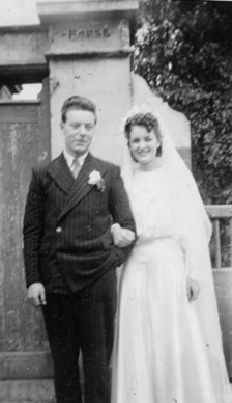
Having exhausted their modest savings, the couple had neither the wherewithal for a honeymoon nor a place of their own. So, with rented accommodation so hard to obtain, they promptly moved in with Neville’s obliging mother, Lizzie, in Margaret Road, Priors Park.[10]
At first the solution seemed to work well with Lizzie handling all the cooking – while laundry arrangements carried on as before the marriage, with Lizzie doing her son’s washing and Doreen doing her own in Cotteswold Road. However, with Neville still out with friends in town every night, Doreen became more and more depressed with her lot. One night, after a heart-to-heart with her father, she asked if she could return to Cotteswold Road and he agreed. When Neville found out that his wife was about to move back to her family, he was incandescent and went round to have it out with them. However, it was Bert who read him the riot act! Outmanoeuvred, Neville promised to mend his ways – but evidently this did not last for long because the same scenario occurred at least once more. To his credit, Bert repeatedly advised the couple that they must start as they meant to go on.
Then things took a distinct turn for the worse when – because of chronic morning sickness – Doreen (now pregnant with Jim)[11] was forced to quit her job at Smiths. Such was the shock to the couple’s finances, Neville advised Lizzie that, from now on, they would be forced to economise by looking after their own meals.
When word of this development reached Tillie, she quickly realised that life had become unsus tain able and that Doreen would have to be rescued.
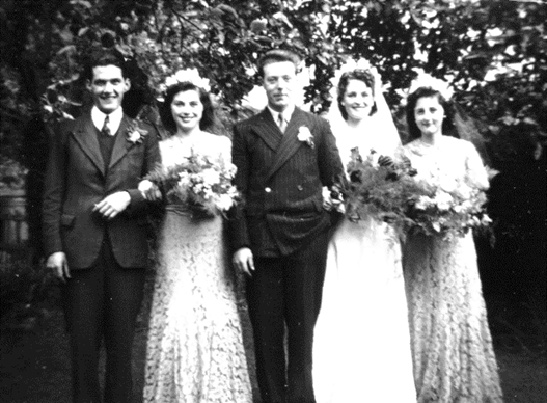
Suddenly salvation came in the form of a family friend, Gertie Hodges, who was just about to vacate 1 Bedford Court. Tillie quickly alerted Doreen to this opportunity and soon afterwards the couple moved into their very first independent accommodation (rent 3s.6d. [18p] per week) – just off the top of the High Street, near the Sabrina Cinema – a mouse-infested, gas-lit, one-up, one-down with both communal washroom and toilet facilities.[12]
Photo: The newlyweds, flanked on the left by bridesmaid, Winnie Reap, and best man, Tony Langley, with bridesmaid Barbara on the right
Bedford Court
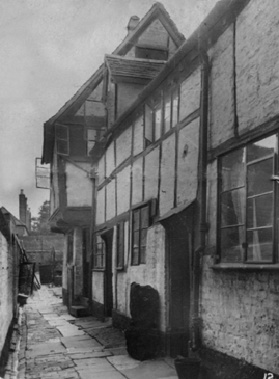
Though this was a major step forward for Neville and Doreen at one level, in other respects long-standing routines continued as before: Neville was out every night and Lizzie was still dealing with his laundry.
In the end it was Doreen who had to broach the laundry matter with her mother-in-law – amazingly, the sensitivity of the situation had been completely lost on Lizzie – with the upshot that, after almost a year of marriage, Doreen finally won the right to do her husband’s washing!
Decades later, Doreen – by now well into old age – looked back on her lifelong marriage to Neville and jested: “If you ’ad the sense of what you ’ave today, you’d never do it!”[13]
References
- Jim Freeman, ‘Neville’s Post-war Preoccupations’, THS Bulletin 20 (2011), pp 36-40.
- 120 High Street, in 2016 the Blue Cross Charity Shop. In 2015 £10 is worth about £300.
- http://little-details.livejournal.com/1614275 [dead]
- Later on in life, Doreen was to comment that “as soon as ’e’d got through the (demob) money, they didn’t want to know ’im” – adding “this army lot with Dad’s drinking was the ruination of your father”.
- Jim Freeman, ‘Forsaking Generations of Alley Life – a Family Retrospective’, THS Bulletin 18 (2009), pp 26-29
- “Airman's Wedding: Miss Nancy Ellen Wilson, only daughter of Leonard Wilson of Mythe Bridge to Aircraftsman Albert Charles Bayliss of 23 Cotteswold Road.” Tewkesbury Register, 02 Sep 1944, p1/3. Exotically, some wedding dresses during the war – and immediately after – were rumoured to have been made of ‘acquired’ parachute silk – but this was definitely not one of them. Doreen recalled that because Nancy was much bustier than she was, she had to pack the top of the dress with cloth to stop it sagging.
- https://en.wikipedia.org/wiki/Something_old
- This pub was at 110 High Street; now demolished and replaced by the shopping precinct.
- The alternative option, famously, would have been to elope to Gretna Green, where no consent was needed for anyone aged over 16.
- Massive slum clearance, combined with the loss of or major damage to more than 1 million homes due to German bombing, had left the country with a severe housing shortage: http://www.localhistories.org/secondlife.html [dead]
- James Freeman, was born on 9 June 1949; April Irwin is his daughter and has ‘A’ Level History!
- Bedford Court has now been replaced by the shopping precinct. In 2015, 18p was worth about £5.40. It was through Tillie that Doreen also found her next accommodation in Priors Park. Tillie used to polish the floors at Bannister’s the chemists in the High Street and, when news of the new housing estate came through, she asked Mr. Bannister, a local councillor, if he would put in a word for her daughter.
- Doreen’s eloquent, exact summation of the problem was that “It was through Gran’s fault - that she idolised ’im”.
Comments