Osborne House Archive
Of The Former Patent Renewable Hosiery Company[1]
The archive contains 42 documents covering dates in 1808 to 1960. The documents show that in 1808 William Handley purchased land in the Oldbury Field from John Maccapen Barnes for £170.[3]
Under the 1811 Inclosure Award William Handley was allotted the following in lieu of that land ? “Unto and for William Handley All that parcel of Land in the Upper Length of the Oldbury Field No.35 containing two roods and thirty five perches” Samuel Turner was likewise allotted land ? “Unto and for Samuel Turner All that parcel of Land in the Upper Length of the Oldbury Field No.38 containing one acre one rood and sixteen perches”
In 1818 Samuel Turner sold his land, 96 yards by 33 yards breadth, to William Handley for £262. In 1825 William Handley sold the whole of the land to George Freeman[4] of ... Surrey for £950.ALL THAT PARCEL OF LAND or garden ground situate in the Upper Length of Oldbury Field in Tewkesbury containing One Acre and One Rood and Thirty Four Perches [1a.1r.34p] bounded. On East and South by certain roads at the back of Barton Street and across the Oldbury Field.On West by Land of John Moore; John Thomas and James Kingsbury deceased.On North by land of Nathaniel Hartland and others together with right of footpath on North of said land to the road on the back part of the High Street – Part of which land was awarded to William Handley in the Inclosure Award and the other part of which was awarded to Samuel Turner and afterwards purchased by said William Handley.
By 1828 George Freeman had erected 7 tenements enclosed by a brick wall on part of the land which he sold to his brother Thomas Freeman for £1,100. These were bounded by: Chance Street and the land of said George Freeman and occupied by John Holland; John Eaton; Thomas Needham; Richard Wheatley; Henry Shepherd; Richard Gill and William Gee as tenants of George Freeman.The 1836 Poor Rate lists George Freeman in the Oldbury with property of House, Factory, Garden and Stock with an annual rental value of £80. The 7 houses in Chance Street are listed with owner as: William Freeman & Co.[5]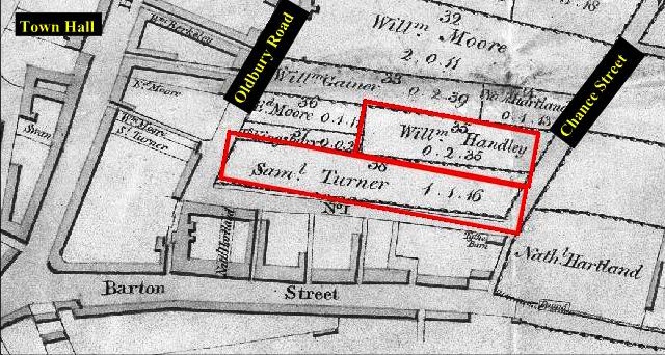
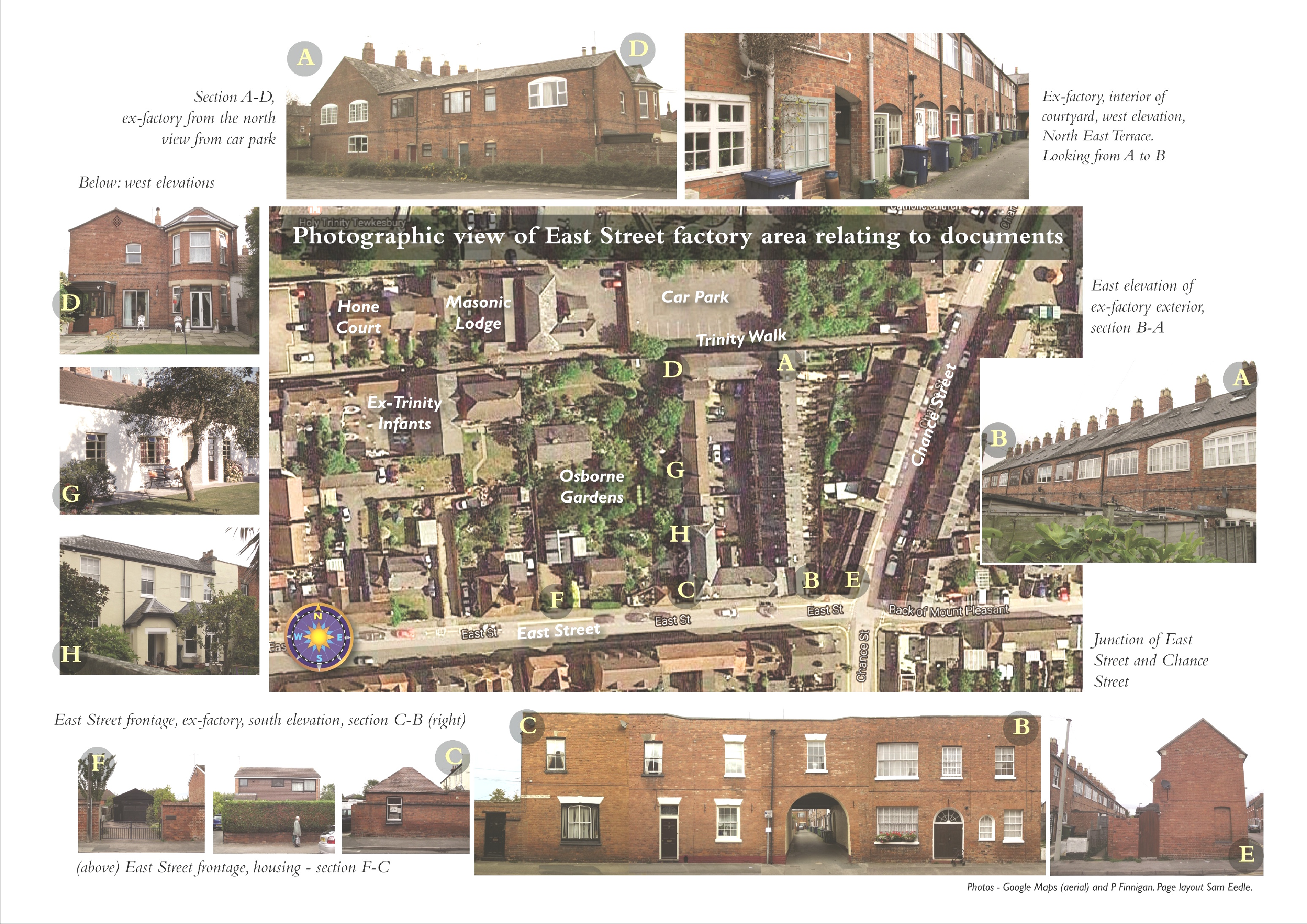
- A 14 Horse Power pressure beam engine by Edwards of Birmingham with pumps and fly-wheel; stone bed, exhaust pipe complete.
- A 20 Horse Power high pressure steam boiler with steam chest safety valves, stopcocks and steam piping. Shafting with drums, riggers and straps.
- A Winding engine for 24 Bobbins.
- 4 Frames on Barton’s Patent with driving gears, straps and riggers.
- 4 Rotary Frames.
- The contents of the Bleaching Houses: Manlove and Alliotts hydro extractor with driving gear, Fullers and Dollys with driving gear, bleaching pans, cockle-drying racks, stoves and apparatus, piping, stopcocks and hydraulic press Lift pump rising main and water tank.
- 29 Sutton wide frames comprising Toppers, Middlers, footers, gusseters and heelers.
- 200 Narrow frames of various gauges from 24 to 44.
- Contents of Blacksmith’s Shop: Drawing tackle, force pairing frames, forge bellows, anvil, vices and vice benches.
In 1862 [presumably having foreclosed on mortgage to Samuel Massey Crosse] Ralph Walters made an agreement with Henry Owen of Albert Terrace Canonbury Middlesex to let the factory and grounds to him for 2 years, at a rate of £300 for first year and £400 for second year with an option to buy during that time at the price of £5,500. The Inventory was listed as:
- SMITHS SHOP: 6 Iron Vices; 2 Anvils; Drawing Machine for Wire; Old Iron Punching Engine; Drilling Machine; 4 Work Benches & Stool; Tools; Model for Frames; 54 Steel Main Springs; Iron Piping Hoop Iron; 113 Bars of round Iron; 12 pieces of Bar Iron; Forge Bellows; Slack Trough.
- POWER FRAME SHOP: 3 Baskets; 80 Deal Boards; Iron Grates; 2 Flights of Steps; 32 Window Frames; 3 Door Frames; 2 Shovels; 3 pieces of Gas Piping; Sundry Wood and Stone; Writing Desk; Gate; 2 Chimney Pieces; 5 Old Doors & Door Frames; Step Ladder; Wheelbarrow
- ENGINE HOUSE: Work Bench; 20 Deal Planks; Quantity of quartering; Ladders.
- IN YARD: 21 Stone Pipes; Wood; Iron Boiler and Fly-Wheel; Bricks; 3 Iron Supports; Paving Stone; Slab Stone; Bleaching Furnace; Iron Standard; Deal Bulk; 5 pieces of timber for leg boards; timber.
- PACKING ROOM: Ironing Board; Cistern lined with Zinc; Long Cupboard; Table; Sundry pieces of quartering; Scoop & Bucket; Quantity of Iron supports; 6 Old Doors; 2 Flights of Stairs; 2 Gas Pipes.
- OFFICES: 7 Bags of Nails; Stone Water Pipe for water closet; Pair Stand Scales; Double Mahogany Writing Desk; 2 Stools; 5 Chairs; Deal Table Matting; Post Delivery Box; Fender and Fire Irons; Japan Candlestick; 4 Flat Irons; 4 Leg Boards; Gas Meter.
- STORE ROOM: 9 Rolls of Spring Wire; Wheel and Runners; Work Bench, Vice; Needle Box, 2 Oil Cans; 34 pairs of New Plyers; 46 Elastic Springs; Quantity of Ditto (broken); 7 Iron Fasteners; 23 Iron Standards.
- TAKING IN ROOM: Box, Dram Scales; Mahogany Writing Desk; 16 Stools; Nest Pigeon Holes with Compartments under range of 4 Shelves; Board & 4 Trestles; Quantity of Bobbins.
- No. 3 WINDING ROOM: Winding Frame Desk.
- IN COTTAGE YARD: Slabbing Stone; Grindstone and Tub.
- CARPENTER’S SHOP: 3 Window Frames; Boards; Bench; 3 Chimney Pieces.
- COTTAGES: 6 Furnaces to Cottages with Stacks; 2 Ditto without Stacks; The whole of the Gas Piping and Burners; 317 [Stocking] Frames in rooms (there were originally 322 but 5 broken and were sent to Nottingham).

‘Illustrated London News’ (R. Ross)Click Image
to Expand
Henry Owen was the Inventor of ‘Improvements in Stockings’ and held the Letters Patent under the Great Seal of the United Kingdom dated 24 January 1859 and had the sole and exclusive licence, power, privilege and authority of making, using, exercising and vending the said invention within the UK for 14 years and in 1863 he agreed to assign these patents to The Tewkesbury Hosiery Co. Ltd.
In 1863 Henry Owen assigns his Letters Patent to the recently set up Tewkesbury Hosiery Company Ltd. with the condition that he, Henry Owen, would be employed as Superintendent or General Manager at a salary of £300 per year and also to receive a share of the profits. The Letters Patent to be returned to Henry Owen when he left the service of the company.
In 1865 Ralph Walters issued a mortgage to the Tewkesbury Hosiery Company Ltd. for £5,500 at 6%, but died soon afterwards leaving his widow Elizabeth and brothers George and Robert executors.
Elizabeth completed the mortgage, agreeing that during the mortgage period the company would pay a yearly rent of £300. All the machinery was also granted to the Company at a peppercorn rent:
Under the Will of Ralph Walters, he appointed his wife Elizabeth … Elizabeth proved the Will on 5th October 1865 and completed the mortgage agreement to Tewkesbury Hosiery Company Ltd. His brother Robert Walters renounced the probate, but brother George Walters proved the Will 10th January 1866 and under a family dispute a decree in the High Court of Chancery 27th July 1866 it was ordered that a proper person should be appointed to receive the writ and profile of the real and personal estate and to collect and get in outstanding personal estate of the testator Ralph Walters.
John Charles Wood was duly appointed receiver in the suit of Walters v. Walters.
George Walters died 5th April 1867 leaving his wife Catherine Walters executrix.
On 5 November 1867 the receiver J.C. Wood agreed a sale to Edward Moore for £1,696.5s.0d. and in March 1868 [all] with the agreement of J.C. Wood and Samuel Hitch, Official Liquidator, of said Tewkesbury Hosiery Company Ltd were conveyed to Edward Moore. Premises then described as:
All That Parcel of Ground in the Oldbury Tewkesbury – 1a.1r.34p – together with the building formerly a Lace Factory and lately A Hosiery Factory, 7 [houses] and all buildings, erections, fixtures.
Edward Moore obviously wanted just the factory [which was now named The Tewkesbury Hosiery Factory] as he immediately put up for sale:
- Seven Cottages and Gardens which were sold to Mr. Edwin Young and Mr. Benjamin Purser.
- Two Pieces of Garden Land sold to Mr. William Winterbotham [solicitor & Town Clerk]
- Two Pieces of Garden Land sold to Mr. John Frost [master of Trinity School]
- One Piece of Garden Land sold to Mr. William Spiers [Coal Merchant]
- Three Pieces of Garden Land sold to Mr. Frederick Lane [Saddler and ‘Gentleman’]
The three pieces of garden land sold to Mr. Frederick Lane for £240 were immediately next to the factory site of Edward Moore and were described as:
All that piece or parcel of Ground in the Oldbury containing in length from North to South on the East side – 194 feet – and on the West side thereof – 194 feet 6 inches and in width from East to West – 75 feet; and containing in the whole 1,614 square yards; and which said piece or parcel of ground are bounded on the North by the Infant School Walk; on the South by the Oldbury; on the East by Garden Land of said Edward Moore; on the West partly by garden Land recently sold by said Edward Moore to John Frost and partly by garden Land also recently sold by said Edward Moore to William Spiers.
In December 1868 Edward Moore bought back the piece of garden land next to his factory for £90.[7] He borrowed money from Messrs. Moore and Romney and Lechmere and eventually in May 1872, under proceedings of liquidation, he sold the main factory buildings to Messrs. Iliffe and the following he sold to William Knight boot and shoe manufacturer for £600.
All those several warehouses or buildings formerly part of Tewkesbury Hosiery Factory (and some of which have recently been converted into a Dwelling House) with yards and outbuildings belonging thereto; and the 12 foot road thereto lying between the same and the other part of the Factory recently sold by Edward Moore to Messrs Iliffe who have joint right of use over such road and all those two several pieces of Garden Land ... adjoining to the said Dwelling house …
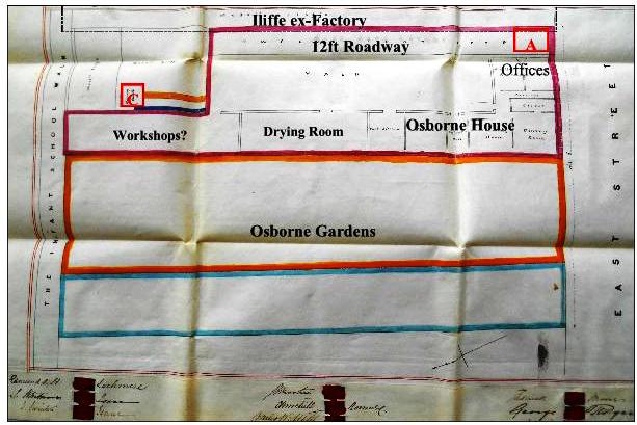
William Knight was a boot and shoe maker, born in Philadelphia, and married Mary Osborne of Tewkesbury in 1850 – possibly why the house was called Osborne House. He was partner in the firm Knight and Ashley who had the Eagle Factory in Church Street [later the Shirt Factory and Faw cett’s and now Elliot Court housing development]. This partnership was dissolved December 1879 and by 1881 the family had moved to Stourbridge.
In October 1880 when he moved to Stourbridge the property [now called Osborne House] was put up for auction [right]. Worth noting are the:
“wine cellaring, the WC, warehouse, 5 bed chambers, 2 yards with a 12 ft. carriage entrance, with folding doors” with right of entry to Mr. Iliffe[8] who owns the adjoining property. In the “ornamental garden” was a “summer house, 2 well-built greenhouses” – and access to Iliffe’s chimney stack in the adjoining garden. [C on 1872 Map]
William Knight sold the house to Miss Janet Jones[9] for £720 – he had taken out mortgages of £500 and £200 with Churchill Romney, which still owed, so he agreed that Janet Jones should pay off the debt and he was paid £20 only. William Knight had also recently agreed with Frederick Lane to purchase the garden ground next to the house for £161.6s.0d. and, as Janet Jones wished to purchase this, Knight agreed for her name to be substituted as the purchaser in consideration of £18.14s.0d. – making a total of £180.
Thus in 1881 Miss Janet Jones purchased Osborne House and a piece of garden land for £900. She lived there for a while – in 1891 Census Janet Jones is living at Osborne House with her nephew Frank Jones but in 1901 Humphrey King an ironmonger was living there. Her brother-in-law George Jones bought the factory from Iliffe for housing development. Janet Jones died in 1911. The factory was converted into houses [which today we call North East Terrace or colloquially Chimney Pot Row] because in 1920 her trustees sold the property to Mr. Charles Anderson for £1,200.
Charles Anderson had a £700 mortgage from the Tewkesbury and District Permanent Benefit Building Society that was endorsed as fully paid in 1925.
The archive finishes with a solicitor’s letter re: the unrelated property of the late Mr. Alfred Hopkins in Jeynes Buildings being vested in Mr. and Mrs. R. J. Finnigan in 1960.[10]
Research from other Sources
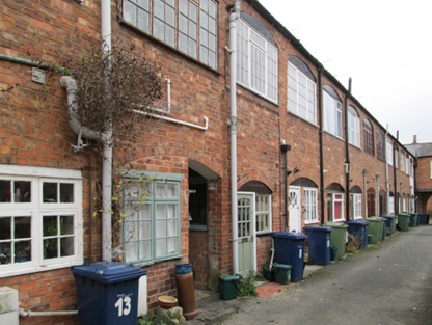
their entrance was on the Chance Street side.
1880: Will of Lydia Jones
On 10th February 1880 the Will of Lydia Jones late of Tewkesbury … widow deceased who died on 4th January 1880 in Tewkesbury was proved in Her Majesty’s High Court of Justice …. attached to the Probate Division at Gloucester by the Oath of Mary Ann Jones of Tewkesbury, spinster and Lydia Hickling Jones of Tewkesbury spinster, the daughters of said deceased. Effects under £4000 ? No Leaseholds.
She also left land in Eldersfield to the two daughters.
… ? to pay and divide the balance or residue of the said monies between my son Joseph Jones and my five daughters ? Eliza Howell the wife of Henry Howell now of Detroit in the United States of America; Kezia Jones the wife of George Jones of Tewkesbury innkeeper; Janet Jones; the said Mary Ann Jones and the said Lydia Hickling Jones share and share alike
… The share of any female being paid to and received enjoyed and disposed of by her as her separate property without the control or interference of any present or future husband
… I appoint the said Mary Ann Jones and Lydia Hickling Jones Trustees and Executrixes of my Will and revoke all former Wills by me made. 29th April 1878 ? signed: Lydia Jones
Proved at Gloucester 10th February 1880
The testatrix Lydia Jones was late of Tewkesbury, a widow and died on 4 January 1880 at Tewkesbury ? under £4000 ? signed: F.J. Brown solicitor Tewkesbury
1886: CouncilCouncil: plan to build houses by George Jones but question of Miss Janet Jones’ private roadway at Osborne House, East Street. She also disagreed with the Surveyor on the cost of the sewer.
We wonder if, despite being in the same family, Janet Jones was not an easy collaborator
Census Research
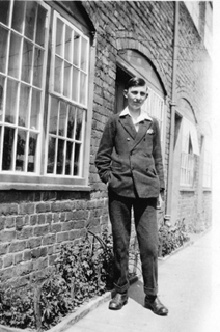
front door of no.4 in the 1930s [Finnigan 2011+ D. Pavey]
1901 Census:
Humphrey King, age 48, Ironmonger, employer, born Fosse Bridge Glos.
1910 Finance Act:
Ref.no.: 1201 Address: East Street Description: House
Occupier: Mr Martin; Yearly Tenancy; Rent £30. Owner: Miss Janet Jones
Details: 3548 Sq.yds … Brick and Slate House in Fair Order. 1st Floor: 4 Large Bedrooms, Dressing Room, W.C. No Bath. Ground: 2 Reception Rooms, Large Kitchen, Back Kitchen and Coals, W.C. Large Garden and Greenhouse. Water from Main.
Gross Rateable Value: £1500 [for whole property]
1911: Will – Janet Jones of Tewkesbury spinster died 10March 1911. Probate London 6April to Mary Ann Jones spinster and Joseph Thomas Jones solicitor. … [her nephew born 1871, son of brother Joseph] – Effects: £4348-11s-8d.
1911 Census: James Martin; Married age 33 Porter Shunter Midland Railway; Born Somerset
1919: Will of Mary Ann Jones of Lisbury House, Bruton, Somersetshire spinster died 9May 1919 – … Effects: £3293.14s.11d.
1920: Town Council ? Surveyor to Lay Sewer for Drainage of Osborne House, North East Terrace
1925: Tragic Deaths of both Charles Anderson and his wife leaving young family[11]
1925: Sale Osborne House and Osborne Cottage purchased by Mr Charles Mellor[12] at £500 and £320
1927: Register Musical Success ? Miss Josephine Organ of Osborne House ? piano under 12
1938: Frank Henry Knight of Osborne House listed as executor re: 2 Barton Terrace[13]
1945: Sale Osborne House, East Street owned by F. H. Knight. ? sold to Jesse Compton for £1,250
1949: Register Tewkesbury Garage Ltd. of 32 High Street; report of injured employee … MD Eric James Neal owned Tewkesbury Garage14 since 1931 + Alfred Henry Manning, works director of Osborne House, had been employed there since 1917.
1955: Marriage: Miss Barbara Hayward of Rowan field Road, Cheltenham to Mr. Terrance Manning of Osborne House, East Street, Tewkesbury.
[In 2016 Osborne House has been subdivided into different dwellings as have some of the factory buildings. In addition North East Terrace remains a terrace of owner-occupied dwellings.]
References
- This topic has also been explored in the following editions of the THS Bulletin: 1993, 1994, 2005, 2006, 2008, 2014, and 2015 ? but these authors did not have the benefit of access to study these documents.
- These documents are due to be deposited into the County Archives by courtesy of the owner, Peter Finnigan. Before that transfer, Wendy kindly agreed to transcribe all the documents for our benefit. Peter has provided photographs of the plot as illustration and the Editor has added contextual material.
- In 1808 £100 was worth at least £7,000; £1,250 in 1945 was worth £45,000.
- For more information see David Aldred, THS Bulletins 2014 & 2015.
- Today seven of them are numbered 22-28 Chance Street.
- We infer from this and the 1861 Trade Directory which records: “A new range of buildings, with a shaft 125 feet high, was erected in 1860-61”, that the Freeman factory had been extended by the new owners.
- Edward Moore was a prime mover to establish the steam-powered factory. A ‘chemist and druggist’ by profession, he was son of wine merchant William Moore and brother to solicitors and land agents.
- George Iliffe was a ‘silk throwster’ who closed the factory in 1878 and moved its effects to Coventry.
- As a woman ‘in a man’s world’ and significant property owner, Janet Jones deserves her own biographer.
- Reginald J. Finnigan’s wife was daughter of Charles Mellor; Peter Finnigan is his son.
- Charles W. Anderson of Osborne House and his wife each suffered “sudden death within a few hours”. The husband had a health problem and the wife’s death was from “misadventure”. [Tewkesbury Register, 8 May 1925]
- Charles Mellor, furniture dealer and councillor of 23 Barton Street, was father of Mrs. R.J. Finnigan.
- Alderman Knight, Mayor four times between 1949 and 1958.
- Since demolished and replaced [in 2016] by ‘Poundland’.
Comments