The Harmonious History of the Tewkesbury & District Choral Society
‘We are the Music Makers, We are the Dreamers of Dreams’
Visit the website of the Tewkesbury Choral Society
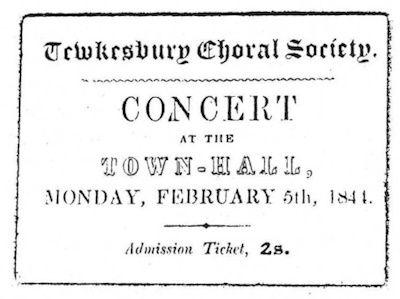
The exact date of the foundation of the Tewkesbury & District Choral Society is unclear. A ticket for a concert in Bushley Shrubberies by the Philharmonic Society is dated 1833, but an entry in the Tewkesbury Registe shows this should read 1883. Another ticket for a concert in the Town Hall by Tewkesbury Choral Society is dated 1844. Despite this, for many years 1868 was regarded by many as the foundation year of the Society.
Concerts have been given under a variety of names – Tewkesbury Choral Society in 1844, The Philharmonic Society from 1882 to 1916, Tewkesbury Choral and Orchestral Society from 1916 to 1946, except for 1922-1924 when they sang as the Free Church Choral Society. In 1946 the Society officially became the Tewkesbury and District Choral Society.
No concert details exist prior to 1882 when the Society’s conductor was Mr. George Watson (1848-1909). According to Mr. W. Linnell, a member of the Society from 1902, Mr. Watson with his two sisters “practically ran the show.” George Watson remained the conductor until 1908, the year before he died. His obituary stated that he had been the “leading spirit of the Tewkesbury and District Philharmonic Society for over 40 years.” The George Watson Memorial Hall, a venue for many of the Choral Society’s concerts, was named after him in recognition of his work for the town of Tewkesbury.
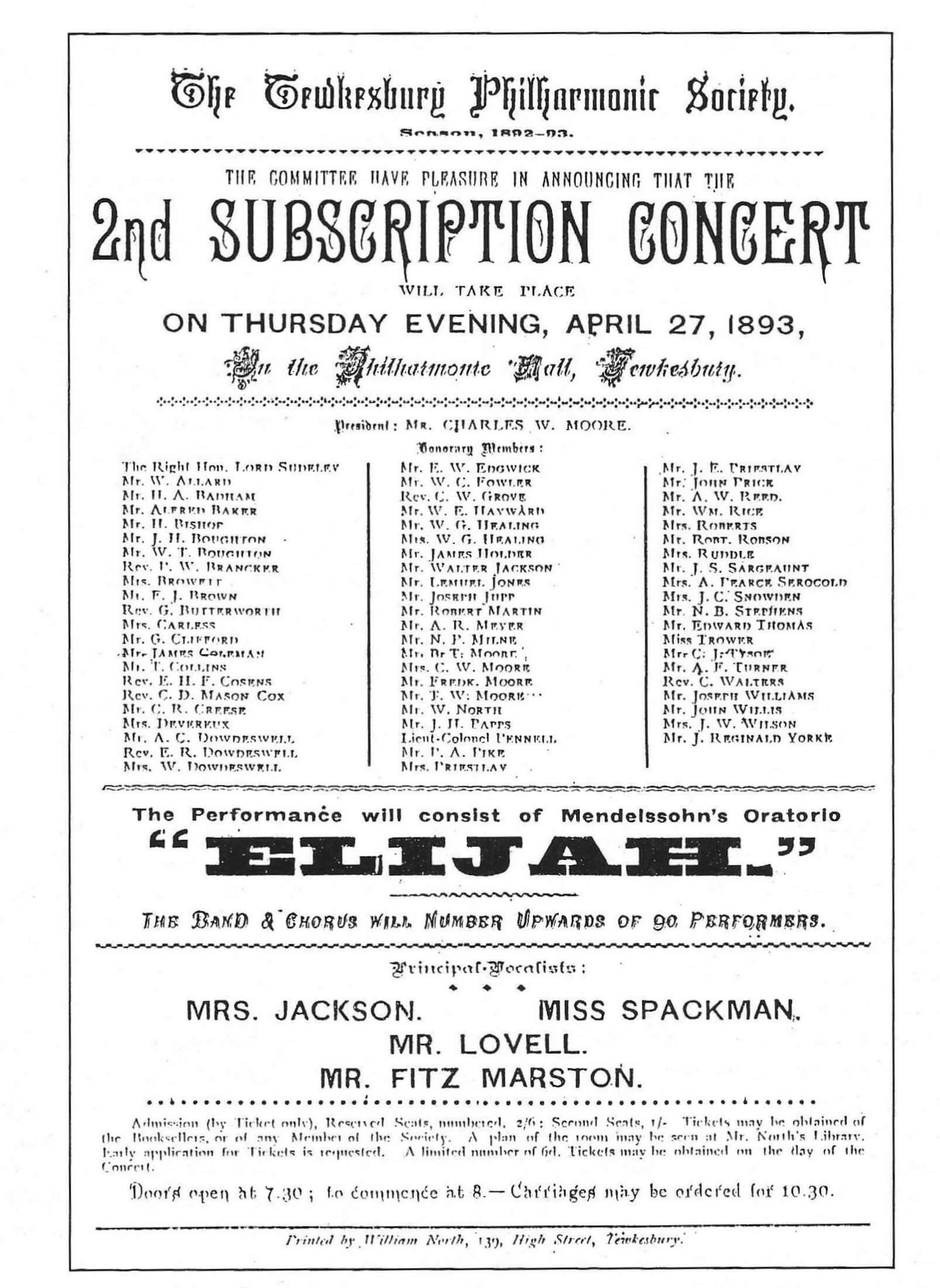
The earliest existing concert programme is for a performance of Mendelssohn’s ‘Elijah’ in 1893, when the “Band and chorus numbered upward of 90 performers.” The Society’s President at this time was Mr. Charles Moore, a member of one of Tewkesbury’s most prominent families. Other notable Tewkesbury citizens are listed among the honorary members or patrons on this programme and include the Rt. Hon. Lord Sudeley, the Rev. Charles Gore, Mr. & Mrs. W. G. Healing, and Mr. W Hayward. A list of patrons, supporters of the Choral Society, is still printed on the concert programmes and continues to include prominent members of the town’s professional and business community.
In the years following George Watson’s death, until after the 1914-18 war, few concerts were given. However, in 1910 Mr. A. W. Vine conducted the Choral Society in a concert to mark the opening of the George Watson Memorial Hall. In 1916, under the baton of Mr. Arthur Billingsly, a performance of ‘Elijah’ was given to raise money for the YMCA’s War Emergency Fund.
-->
The Society regrouped in 1919 to take part in the Peace Celebrations with Capt. Percy Baker, Abbey organist and choirmaster, as conductor. Later that year attempts were made to revive the Tewkesbury Philharmonic Society and again in 1921 as the Tewkesbury Choral and Orchestral Society. In 1922 the Society, under its conductor Mr. N. B. Hill, was refused permission to hold a concert in the Abbey unless the performance was conducted by the Abbey Choirmaster, Capt. P. Baker.
Mr. N. B. Hill died in 1923 and Capt. Baker was appointed as the Society’s conductor, a post he retained until 1932. It was hoped that he would infuse new life into the Society. However, only three concerts are known to have been conducted by him and little has been recorded of the Society’s activities during this period.
From 1922 to 1924 concerts were given under the name of the Free Church Choral Society and conducted by Mr. W. Linnell . During the 1924-25 season a dispute arose when the Choral Society rehearsals clashed with meetings of the Dickens Society. Regular concerts were again introduced in 1932 and it was decided that these would consist of one secular and one sacred concert each year.
1933 saw another important and dynamic Tewkesbury citizen elected to the Committee of the Choral Society in the person of Mrs. Elizabeth Wyatt. She became Chairman in 1934, a position she held for over 20 years.
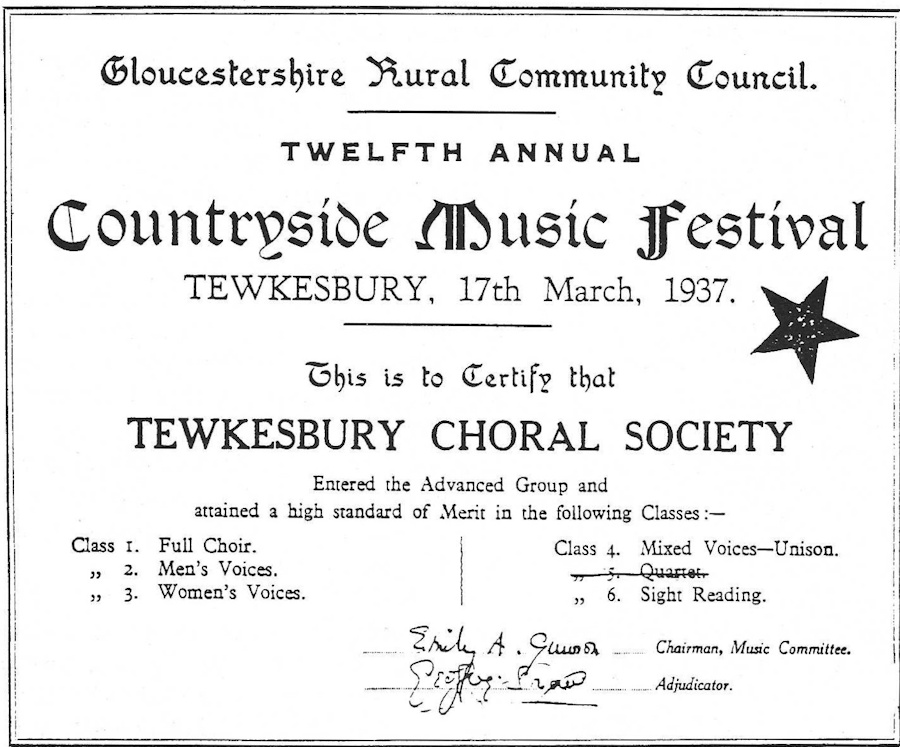
Under the baton of Mr. W. Westcote the Society began to attract new members and at the Countryside Music Festival in 1937 the choir gained the Gold Star for Highest Marks in the tests, which included sight-reading. Individual members also gained gold and silver stars in various groups and four were chosen to take part in a Royal Command Performance later that year.
Elizabeth Wyatt introduced social evenings to encourage members to meet informally. By 1939 membership had increased to 75 and concerts were attracting larger audiences. Sadly war again intervened, concerts were cancelled, and activities scaled down. Few records were kept but some members did meet on an informal basis to practise short choral pieces, but no concerts were given.
‘Each Age is a Dream that is dying or one that is coming to birth’
In 1946, with the return of peace, the Society was reborn as Tewkesbury and District Choral Society, a four-part choir, and would in future hire the orchestral players required for concerts. Membership numbers were again low and fluctuating. Petrol restrictions and the choice of less popular works were deemed to be the cause of poor attendances at rehearsals. Eric Woodward became the permanent conductor in 1947 and made a plea to members not to absent themselves from rehearsals because the music was not to their taste.
Money was as ever a constant worry, more funds being needed to pay for the hire of orchestral players. A sub-committee was therefore formed to put on Jumble Sales and other social and fund-raising events. This practice continued until the late 1980s and has recently been revived to some extent, to raise funds for a work which has been commissioned for the Millennium concert in May 2000.
In 1952 Laurence Hudson replaced Eric Woodward as conductor, a position he was to hold for the next 17 years. It was a period of successful growth and development for the choir. A banner headline in the Tewkesbury Register & Gazette of Saturday 17th October 1953 pronounced the Society as a “big asset to the town” and, “in conjunction with the facilities offered by the Abbey, the Tewkesbury and District Choral Society can put the town on the map as a centre of musical interest.”
1956 saw Elizabeth Wyatt elected as President of the Choral Society. Her work for the Society had been long and consistent and she was instrumental in making Tewkesbury well-known to many celebrities in the musical world. She had brought an organising ability plus the essential routine ‘spade work’ every Society needs. She was a driving force in the town, especially in her work for the elderly. There may have been many younger and physically more active people than Mrs. Wyatt, but it was doubted if any exceeded her in perseverance and determination. Mrs. Wyatt resigned as President in 1969, saying how pleased she was that the Choral Society was now on such firm ground. She died in 1974 at the age of 90.
Laurence Hudson continued to work tirelessly to improve the standard of the choir, personally buying and making available to the choir a much needed replacement for the rehearsal piano. His efforts were rewarded in a fine performance of Haydn’s ‘Creation’ in May 1961 but, as the then Vicar deemed applause in the Abbey unsuitable, the audience was unable to show its full appreciation. Thankfully times have changed.
Coleridge Taylor’s ‘Hiawatha’ was chosen for performance in 1963; it was a popular work at the time and had been on the Choral Society’s programme on several previous occasions. Although rarely heard today, it has close connections with Gloucestershire. It was through Sir Edward Elgar’s intervention that Coleridge Taylor accepted a request to write a work for the Gloucester Festival, finding his inspiration in the Indian legends.
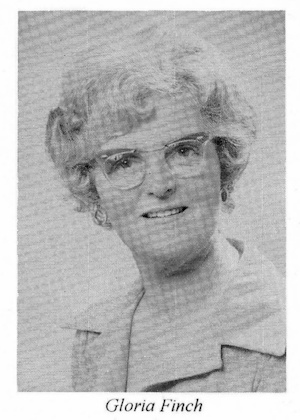
Gloria Finch made the first of many appearances as soloist with the choir in 1965. Thirty-three years later, in December 1998, she was the alto soloist in works by Beethoven and performed the Brahms ‘Alto Rhapsody’ assisted by the male voices of the choir. Her latest appearance was in the ‘Messiah’ in November 1999.
In 1966 ‘Seven Sea Songs’ by Anthony Hewitt-Jones were on the programme. Tony Hewitt-Jones, at this time the Gloucestershire Music Advisor, had been associated with the choir for many years, acting as accompanist from 1955 to 1958. He was also founder of the Gloucester Concert Orchestra, who have played regularly with the choir ever since. In 1969 Ian Partridge, the well-known tenor, then in the early days of his career, was soloist in a performance of Benjamin Britten’s ‘St. Nicolas.’
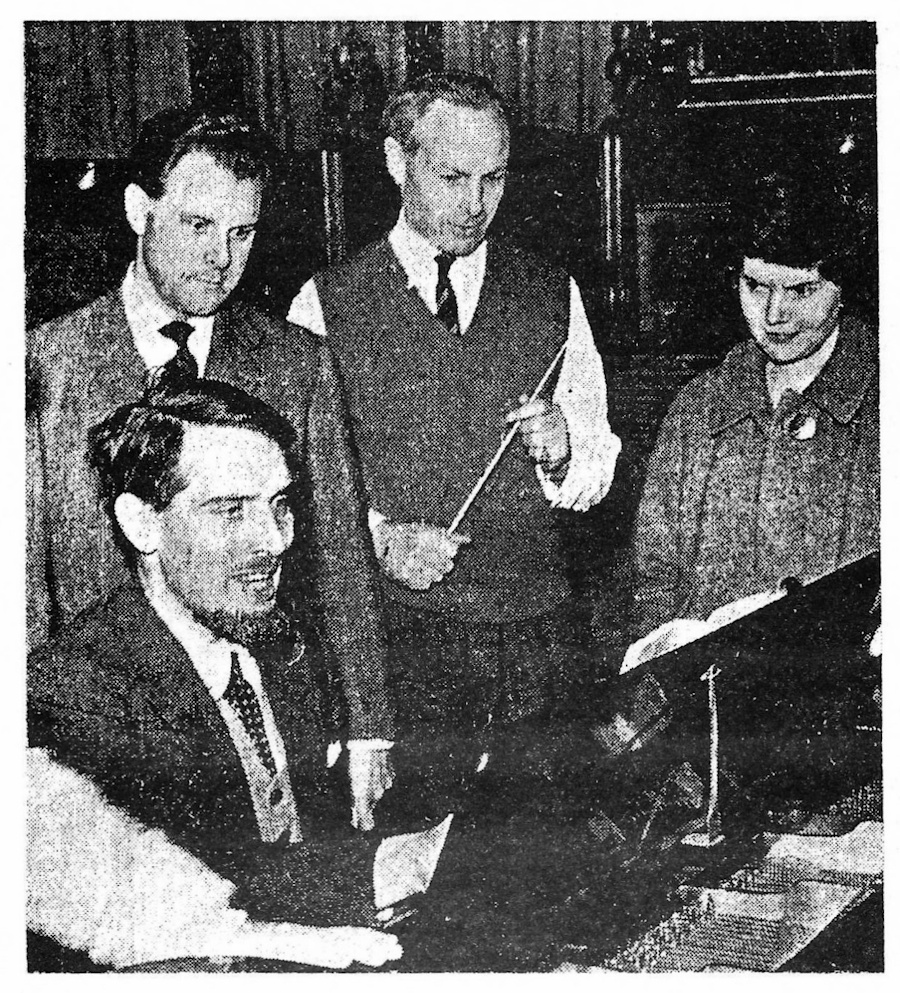
Under the baton of Laurence Hudson the Choral Society had continued to make great improvements and they were sad to lose him when he retired in 1970. He was replaced by Michael Peterson, the organist and choirmaster at the Abbey.
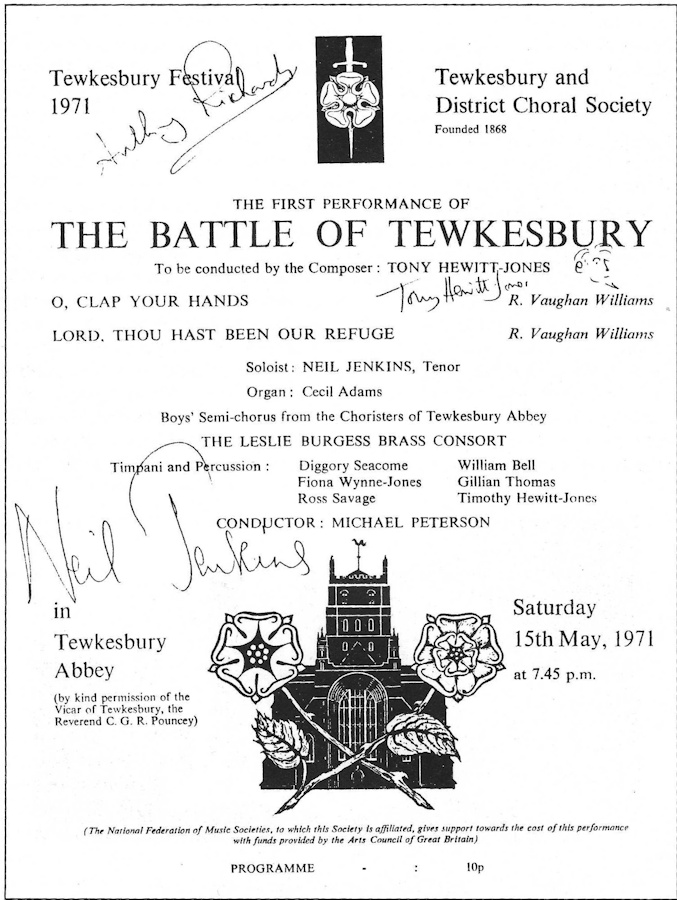
1971 was a Festival Year to celebrate the 500th anniversary of the Battle of Tewkesbury. Anthony Hewitt-Jones had been commissioned to write a work for this occasion and in May conducted the choir in a performance of his ‘Battle of Tewkesbury.’ The work was an outstanding success, receiving high praise from the critics who also commented on the increasingly professional attitude of the choir and its ability to tackle modern works. A member of the choir at this time wrote of the problems faced in rehearsing this work due to the fact that they worked from photocopies which arrived section by section from various locations, even as far away as Poland.
In 1972 William Linnell celebrated seventy years as a member of the Choral Society. He had joined the Band Section as a cornet player in 1902 and in 1922, after the death of N. B. Hill, conducted the choir in the two concerts that year.
In May 1972 Felicity Lott, a young singer from Cheltenham, then at the start of a career which was to take her to the top, joined the choir as soloist in a performance of ‘Dido and Aeneas.’ A member of the choir at the time remembers that Felicity Lott had been very critical of her own performance on this occasion, which she felt had not been up to her usual standard. Already a perfectionist, it seems.
Michael Peterson, due to pressure of work and teaching responsibilities, was obliged to resign as conductor of the Choral Society in 1974. The search for a replacement began. John Yarnley conducted the concerts in 1974 and 1975, and Charles Brett the spring concert in 1976. In the autumn Leonard Blake joined the Society as permanent conductor and remained with the choir until 1980.
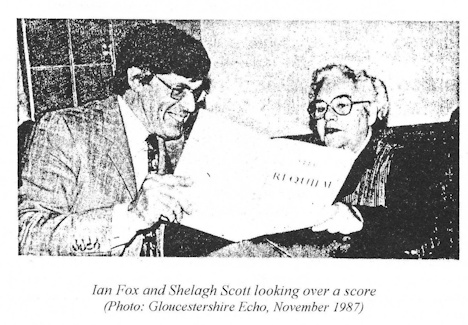
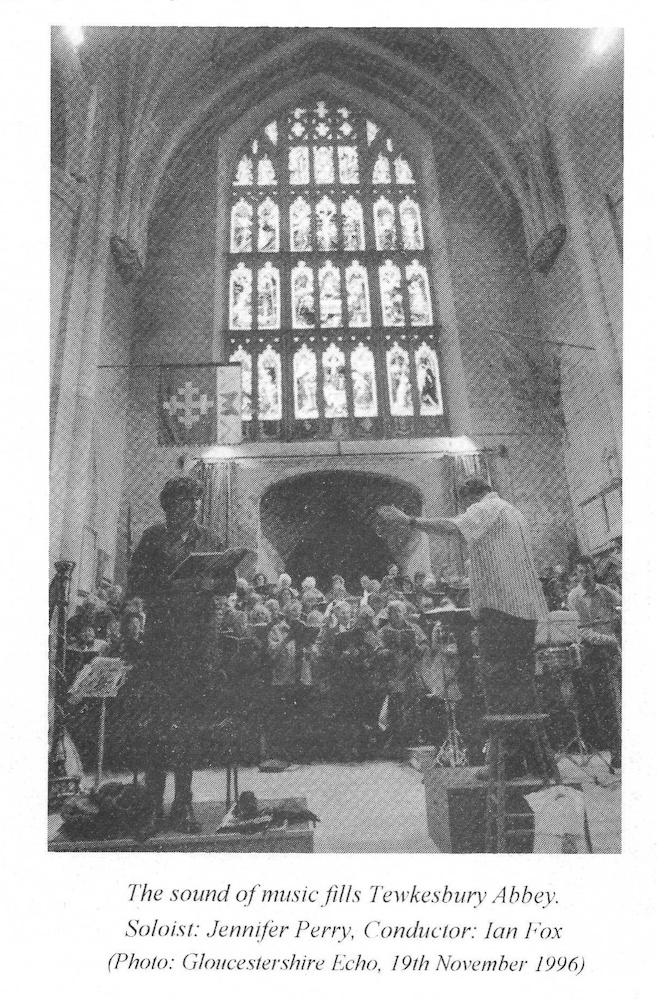
Following the resignation of Leonard Blake in 1980, Ian Fox joined the Choral Society and he has conducted the choir now for nineteen very successful years. His first concert in 1981, a performance of Rossini’s ‘Petit Messe Solonelle,’ was enthusiastically received and special mention was made of the brilliant playing of Shelagh Scott and Michael Peterson at the piano and harmonium and the singing of the alto soloist Gloria Finch, especially in the ‘Agnus Dei.’ After a performance of the Fauré ‘Requiem’ in 1982 the choir was acclaimed as a ‘musical force’ to be reckoned with and their future under the baton of Ian Fox looked bright.
The choir was faced with an emergency in 1983, when the bass soloist withdrew on the morning of the concert. Rev. Michael Moxon, then Vicar of the Abbey, came to the rescue. Before coming to Tewkesbury he had been precentor at St. Paul’s Cathedral. He had only the afternoon to rehearse the bass part as Christus, in Schultz’s ‘St. Matthew Passion,’ but the results delighted both choir and audience who felt they could not have had a better soloist.
Choir numbers had steadily increased since the arrival of Ian Fox. His professional yet relaxed attitude to rehearsals made them pleasing and enjoyable occasions. With Shelagh Scott, a pianist and musician of great merit, as accompanist and helpmate, they made a formidable duo.
In November 1985 the choir performed the first of Elgar’s great choral trilogy, the ‘Dream of Gerontius,’ followed in May 1989 by the ‘Kingdom’ and in 1991 the ‘Apostles.’ Ian Fox continued to receive excellent reviews of his work with the Society. “His bouncy style means he is always on his toes, so too are the singers,” were the comments after a performance of Vivaldi’s ‘Gloria’ in May 1988.
The concert in November 1989, with its maritime theme, consisted of works closely linked with Gloucestershire and the Three Choirs Festival: Elgar’s ‘Sea Pictures’ and Vaughan Williams’s ‘Sea Symphony.’ The performance was seen as a ‘choral triumph’ with the local soloist, Diana Wakely, giving a remarkable performance of the ‘Sea Pictures.’
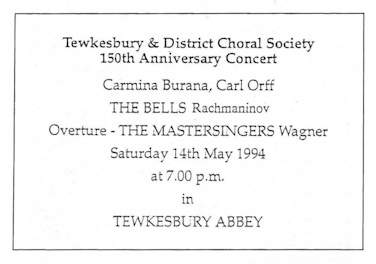
The Choral Society celebrated its 150th anniversary in 1994, having missed out on its centenary due to the difference of opinions as to the date of its foundation. 1844 was now accepted as the earliest proof of the Society’s activities and it was time to celebrate. The May concert included Rachmaninov’s ‘The Bells’ and Carl Orff’s ‘Carmina Burana.’ In December a concert of Royal Music brought the anniversary year to a close. Another reason for celebration was the knowledge that the reputation of the Tewkesbury and District Choral Society was spreading far and wide and, as the press now proclaimed, the Society’s concerts were now filling the Abbey.
With the death in 1995 of Canon Patrick Shannon, the Society lost one of its most loved and talented members. Pat Shannon and his wife moved to Tewkesbury on his retirement in 1975, entering fully into the life of the Abbey, and Pat was an enthusiastic member of the choir right up to his death. A talented musician, he had in his early days played at a variety of Glasgow cinemas and directed some of Scotland’s most famous dance bands. In the choir, Pat’s powers of watching the conductor at rehearsals for every lead, was a lesson to all. When Ian Fox was away, he would take the rehearsals and exhaust the choir with his energetic attacks on some of the problematic sections of the work being practised. With the same energy and skill he would replace the accompanist when necessary. Last but not least, he was a great entertainer and performed at the Christmas concerts and end-of-season parties.
In 1983 Pat Shannon had persuaded his personal friend, the great oboist Leon Goossens, to come to Tewkesbury and play in a concert he had arranged to raise funds for the Choral Society, of which he was at the time Chairman. The 86-year-old Leon Goossens played a varied programme of short pieces accompanied at the piano by Pat Shannon himself.
Personal memories of his friends and acquaintances show us the multiple talents of a remarkable man. Each year, for example, his Christmas cards would have a canon, in the musical sense, or another composition of his own, printed on them and he would compose music for the weddings of his family and friends.
While the Choral Society’s principal trainers and motivators at this time were Ian Fox and Shelagh Scott, they were aided and abetted by Pat Shannon. The concert in May 1996 was a performance of Bach’s ‘St. Matthew Passion’; this had been planned by Pat Shannon, who had engaged the help of Neil Mackie and students of the Royal College of Music. The performance was therefore given in memory of and as a tribute to him.Shelagh Scott had retired as accompanist in 1991 but came back after a year’s break, finally taking her leave of the choir in 1995. A remarkable pianist, she had always been more than just an accompanist. Her presence was felt at all times, whether guiding a section through a difficult moment from the piano or prompting and advising Ian Fox over a problematic spot in the score. By her look in the direction of singers, she warned those she felt were out of tune or failing to watch the conductor’s baton.
Tewkesbury and District Choral Society’s close relationship with Tewkesbury Abbey has been a long and happy one. Singing in the Abbey is for all a thrilling experience difficult to describe. Long may the Society’s harmonious sounds be heard there.
‘Our souls with high music ringing: O men must it ever be,
That we dwell, in our dreaming and singing, a little apart from ye.’
Comments